Working with the Elements - Why Dull Photography doesn’t have to be Dull!
What’s better than Great Western steam? Well Southern steam, but when a Great Western locomotive is working hard with a goods train, even the most loyal SR enthusiast has to enjoy the spectacle. Across two photographic charters, one on the East Somerset Railway and the other on the Gloucestershire and Warwickshire Railway, we explore two very different Great Western engines, paired with contrasting rakes of freight stock.
From flat, overcast skies to a fleeting burst of sunlight, these days were a reminder that photography isn’t just about perfect light. It’s about reading the conditions, working with atmosphere, and finding ways to create strong, evocative images even when the weather refuses to cooperate. In this blog, we’ll look at how dull light can still produce compelling photographs, and how subtle changes in approach can make all the difference.
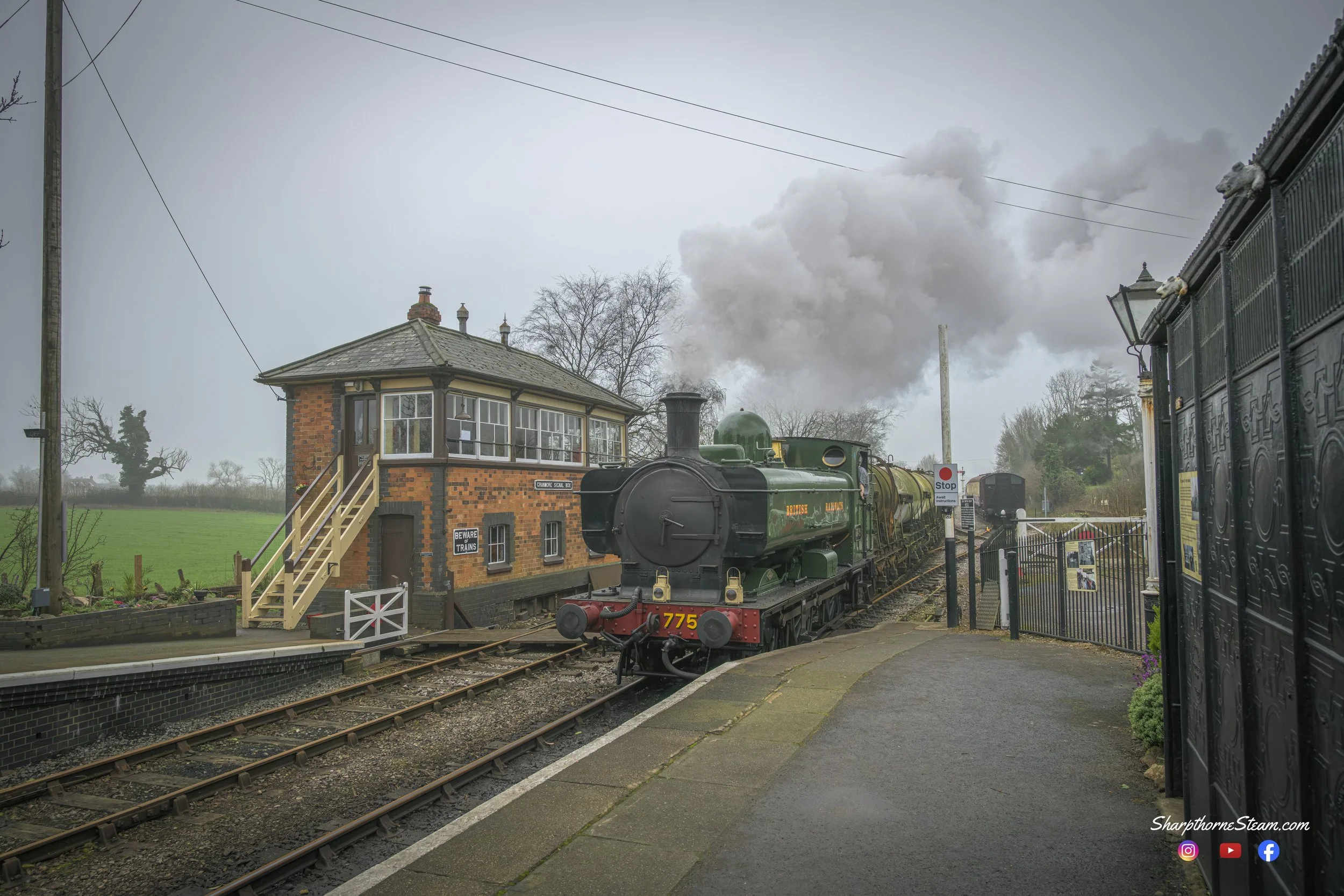
The Base of the East Somerset Railway, Cranmore. The site which includes the station, signal box as well as the Cranmore MPD about a ¼ mile walk past those box vans to the right of 7754 is a great place to enjoy some photographs and also look at the shed and see these wonderful locomotives being prepared for service.
The first GWR charter was my second outing with 30742 Charters, this time at the East Somerset Railway. Picturesque it certainly can be—although on this occasion, fog followed me relentlessly from home all the way to Cranmore. Conditions were a stark contrast to the sunshine enjoyed by gala visitors the following weekend, but challenging weather should never be a reason to put the camera away—especially when the subject is as engaging as No. 7754.
No. 7754 is a 5700 Class pannier tank, built in 1930 not at Swindon, but by the North British Locomotive Company in Glasgow. After service with the Great Western Railway, she passed to British Railways at nationalisation in 1948, before being sold to the National Coal Board in 1959. Today, the locomotive is resident on the Llangollen Railway, and was visiting the East Somerset Railway for their Spring Steam Gala.
This charter was also my first experience travelling between locations aboard a brake van—in this case, a GWR Toad. Standing out on the veranda proved far more rewarding than sheltering inside, particularly at the first location at Mendip Vale. By this point, the fog was firmly established, creating an eerie atmosphere where visibility dropped so low that the train would occasionally disappear entirely.
While such conditions might frustrate some photographers, they present a perfect opportunity to experiment. Black and white is the obvious choice, but for me the real challenge lies in producing a strong colour image in flat, grey light. Working with the fog rather than against it is key. Natural features such as bare winter trees, or lineside details like sleepers and signals, add structure and depth to an otherwise muted scene.
In the image below, timing was everything. I wanted the distant signal to align with the end of 7754’s bunker, guiding the viewer’s eye naturally towards the locomotive while still providing enough visual interest to hold attention. The exhaust plays its part too, adding texture and separation against the gloomy sky. It may sound like an obvious tip, but using burst mode here is essential—it dramatically increases your chances of capturing that precise moment when everything falls into place.
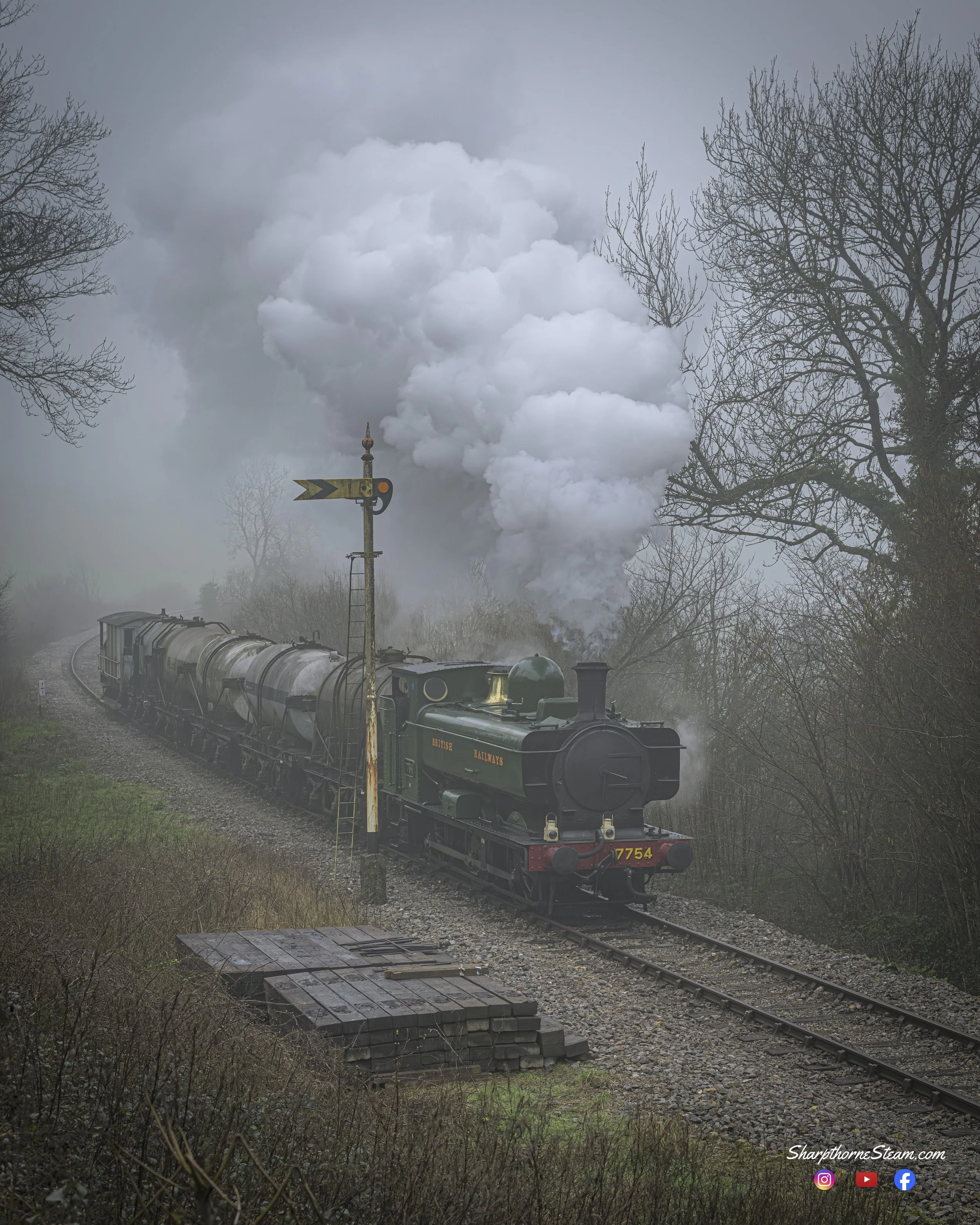
The mixture of railway infrastructure, trees and fog working with the exhaust helps this photo stand out. This was my first time photographing at a different railway other Bluebell in the fog. It was a challenge but I am definitely pleased with the results.
Camera Settings: Camera: Nikon Z8, Lens: Tamron 35-150mm F2-2.8, Focal Length: 57mm, Shutter: 1/640second, Aperture: f/6.3, ISO: 400
Another technique I’ve been deliberately working on this year is panning. Panning is the makes use of a slow shutter speed while moving with the subject, allowing motion blur in the background and wheels to exaggerate a sense of speed and motion.
Until recently, I had largely relied on commonly suggested settings, around 1/60th, often quoted on photography websites. In practice, many of these recommendations are aimed at mainline trains rather than the slower speeds typical of preserved locomotives. Since September last year, I’ve been consciously revisiting panning, gradually pushing the shutter speed lower as my confidence and consistency have improved.
Normally, I’d be reluctant to attempt panning on a charter, but given the flat conditions on the day, it felt like there was little to lose. Multiple run-pasts are invaluable for this kind of experimentation, offering immediate feedback on technique and timing. I began at 1/20th, having previously tested 1/25th, and set out to see how far I could push the limits before the image became unusable.
The first attempt was passable, but my technique lacked consistency. Rather than backing off, I went further, dropping to 1/15th to give 7754 as much visible motion as possible. The aim was to include the leading milk tanks while keeping the locomotive dominant in the frame. Achieving clean motion blur, I find difficult with a single connecting rod, but a quick review on the rear screen showed just enough blur to suggest real movement and speed.
There’s still work to do, particularly in improving my keeper rate, but compared to last year I’m attempting far more panning shots. Increasingly, panning has become my preferred approach for side-on views, especially when dull weather limits the impact of more conventional compositions.
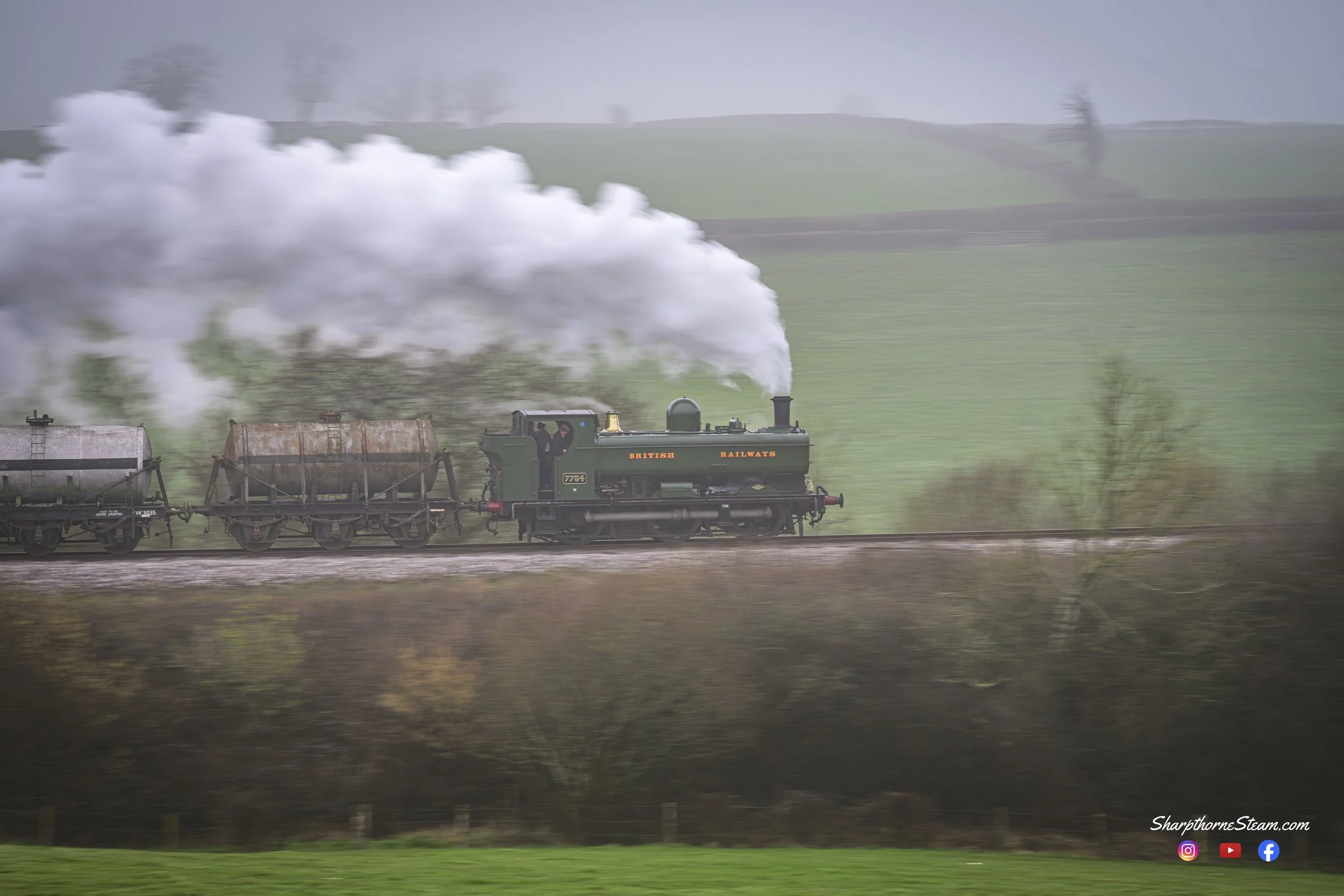
A Rapid Pannier - No7754 accelerates through the Somerset countryside with a branchline milk train racing for market. Being smooth and also making sure the autofocus tracks the side tanks rather than the connecting rods is key. Sometimes my Nikon does enjoy focusing on the con rods. But be prepared that quite a number of photos will be throw aways.
Camera Settings: Camera: Nikon Z8, Lens: Tamron 35-150mm F2-2.8, Focal Length: 90mm, Shutter: 1/15second, Aperture: f/13, ISO: 64
Another technique I’ve been deliberately working on this year is panning. At its core, panning is the controlled use of a slow shutter speed while moving with the subject, allowing motion blur in the background and wheels to exaggerate a sense of speed and effort.
Until recently, I had largely relied on commonly suggested settings—around 1/60th—often quoted on photography websites. In practice, many of these recommendations are aimed at mainline trains rather than the slower speeds typical of preserved locomotives. Since September last year, I’ve been consciously revisiting panning, gradually pushing the shutter speed lower as my confidence and consistency have improved.
My next opportunity to experiment with different approaches came at one of my favourite railways in the country, the Gloucestershire and Warwickshire Railway, on another charter with 30742 Charters. The subject was the recently returned GWR 2884 Class No. 3850, paired with a superb rake of GWR wagons and a Southern Region Queen Mary brake van.
Once again, cloud cover defined the challenge. Unlike the East Somerset Railway, there was no mist to add atmosphere, and the light was flatter and more subdued. In conditions like this, creativity becomes essential, particularly in your choice of angles, to produce images with impact.
One technique I return to time and again is shooting from a low viewpoint, looking up at the locomotive to emphasise its scale and presence. Steam locomotives are imposing machines by nature, and a low angle exaggerates that sense of power. However, when working this low it’s important to be mindful of the locomotive’s cylinders and motion. From certain angles these key features can easily overlap or disappear behind the frames, so timing the shot when the motion is visually “open” helps maintain clarity and shows the locomotive working at its best. In the photograph below, I wanted the connecting rod to be at its lowest reach, adding another aspect to the shot and giving the viewer more interest.
While this approach can be harder when shooting fence-side rather than line-side, the right location can make all the difference. A simple trick is to let the landscape work for you. Even a small natural rise can provide just enough elevation to help isolate the locomotive from the background and increase its visual dominance. In this case, the location was the exit of Greet Tunnel, shooting from the left-hand side of the line when facing the tunnel.
For shots this low, the viewfinder becomes impractical, so you have to rely on the rear screen. With the Nikon Z8, the hinged screen allows you to compose comfortably at ground level. Getting as low as possible is critical, but you still need to maintain a strong, balanced composition. In this instance, I opted for a portrait orientation, which adds height and drama, but with a hinged (rather than fully articulating) screen, this does make composition more challenging and requires extra care.
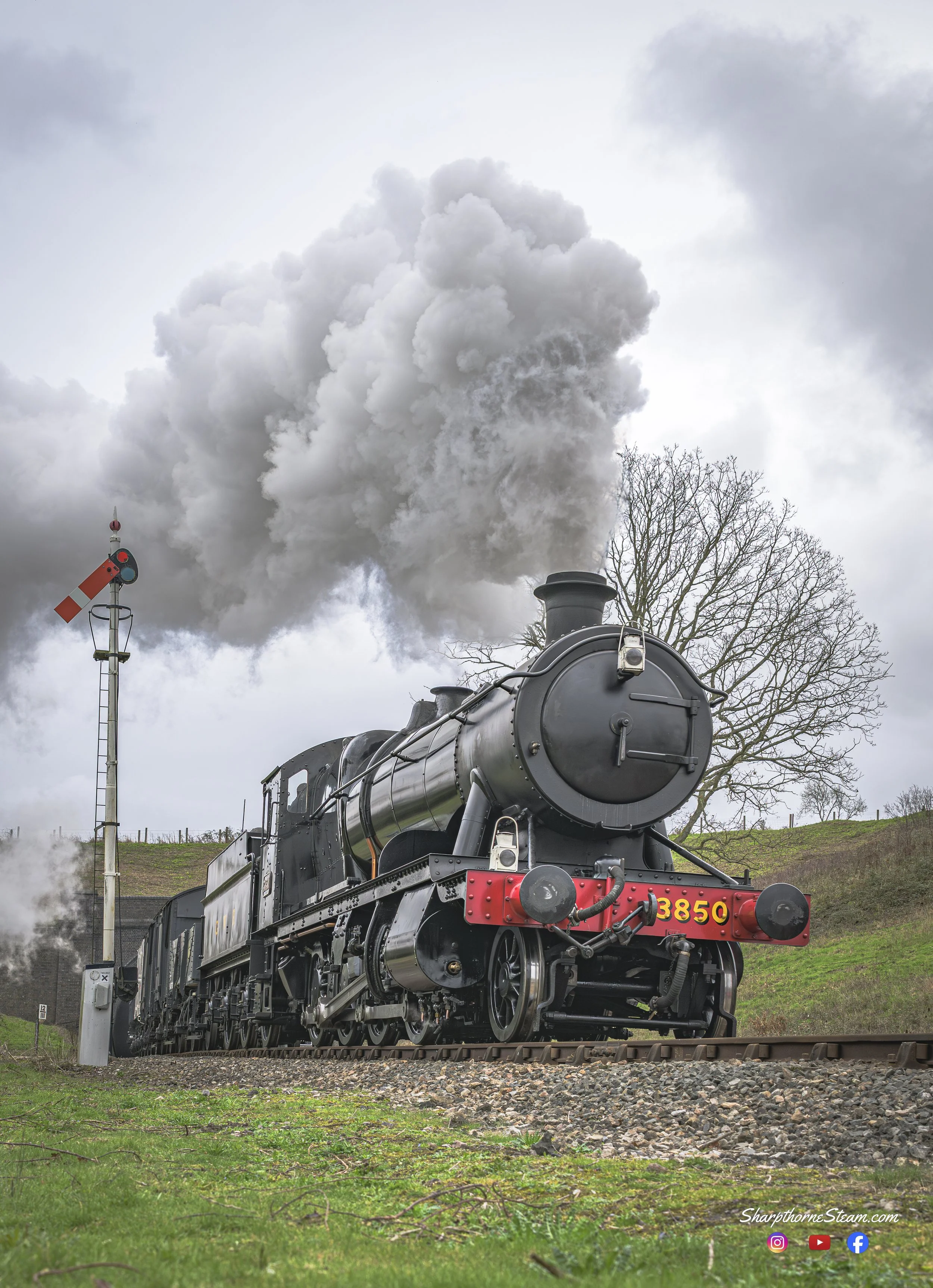
No. 3850 powers out of Greet Tunnel and charges towards the camera with her goods train! The final composition has been significantly tightened in post-processing. This is one of the key reasons I value a high-resolution, 45-megapixel camera: the ability to crop with confidence. Subtle cropping can refine balance, remove distractions, and ultimately help realise the image you may not have fully visualised at the moment of capture, without compromising image quality.
Camera Settings: Camera: Nikon Z8, Lens: Tamron 35-150mm F2-2.8, Focal Length: 35mm, Shutter: 1/640second, Aperture: f/5.6, ISO: 250
The final creative option that dull weather opens up is black and white photography. I’ve lost count of how many times I’ve heard photographers say, “it’s black and white weather today” and while the phrase is often said half in jest, there’s a great deal of truth in it.
For steam locomotive photographers, black and white has an almost magnetic pull. Whether we admit it or not, many of us are subconsciously chasing the monochrome images of the 1950s and 1960s, especially those of us who never experienced the final years of British Railways steam first-hand. In dull conditions, black and white doesn’t feel like a compromise; it feels appropriate to try and get to that elusive goal.
One of its biggest strengths is the removal of weak or distracting colour. Flat light can leave skies lifeless, vegetation muddy, and ballast tones unappealing. By stripping colour away entirely, attention is drawn back to what matters most: the locomotive itself. This can be particularly effective when photographing already black engines, such as No3850, where monochrome helps the subject stand out more clearly against its surroundings.
Black and white also allows contrast to be creatively controlled. Where dull conditions often lack natural separation, monochrome processing lets you darken skies, lift highlights in steam, and subtly shape tones to give the image depth and impact that colour may struggle to deliver. Used carefully, this can rescue images, or even elevate them beyond what a colour version could achieve.
A good example for me was a photograph taken on the Spa Valley Railway during the Cuckoo Line gala, featuring 80078. Strong but uninspiring light had produced washed-out colours, yet the black and white conversion transformed the image, giving it clarity, balance, and a far more timeless feel.
Ultimately, black and white photography aligns perfectly with dull weather. It embraces mood over colour, atmosphere over brightness, and heritage over modernity—making it a powerful tool when conditions refuse to play along.
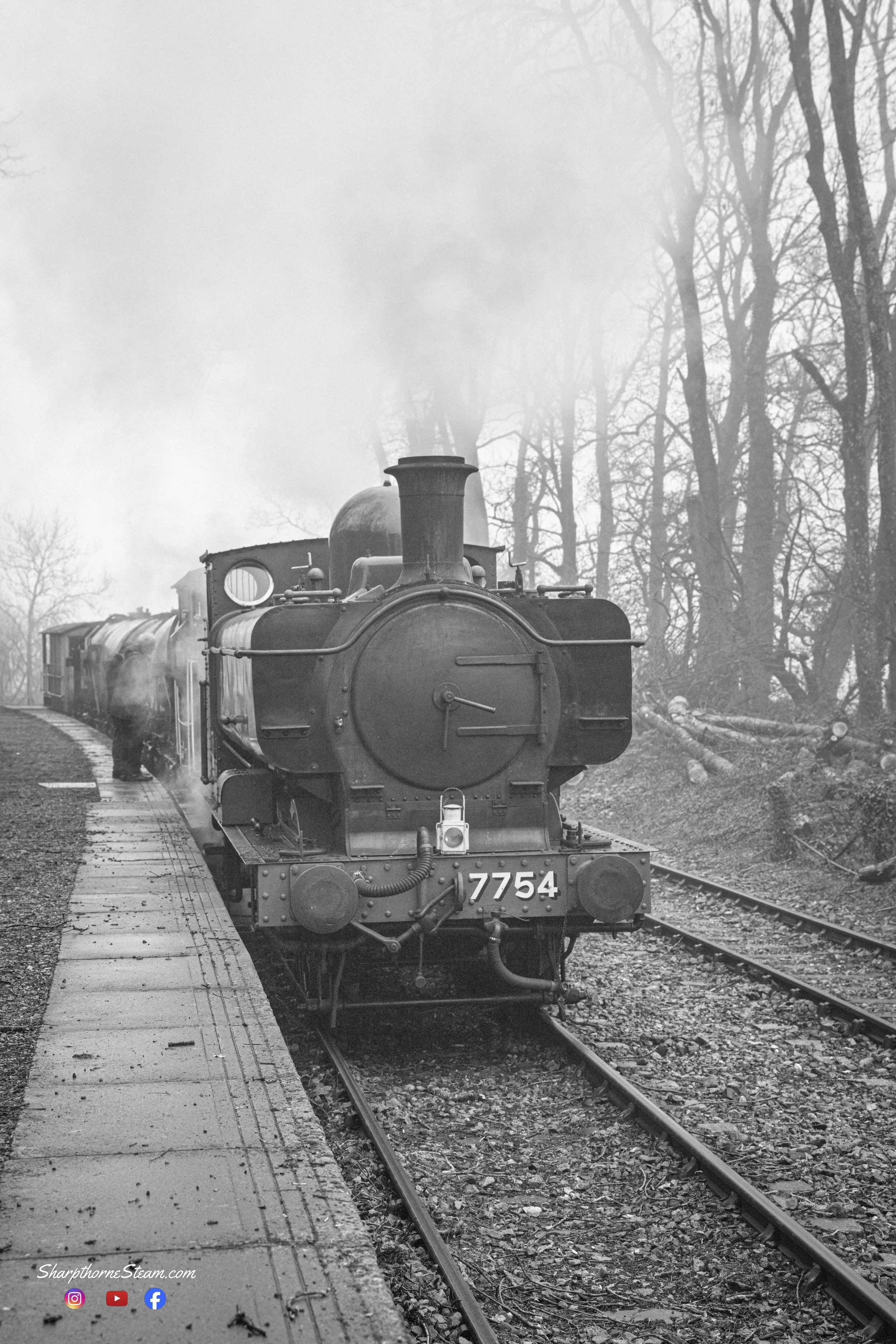
An attempt to hark back to the days of the 1960s with 7754 at Mendip Vale station with a Milk tank train. An element of grain is added in to the photo to try and reproduce the British Railways era. However, it still has all the hallmarks of a modern camera when compared to a camera used in the 1960s.
Another blog comes to an end and I would be very interested to hear how other photographers get on with photographing in dull weather, if you have any further tips or tricks, then please comment down below. I am writing this on the Wednesday before the Bluebell Railway’s Spring Steam Gala and I keep checking in with the weather and my weather men on the Bluebell Bashers group to make sure that we don’t have another weekend of dull weather, here’s hoping for wall to wall sunshine but not too hot so that it removes exhaust (not being too picky a photographer). I hope readers have a fantastic Bluebell gala weekend and fill their cameras with lots of fantastic shots of W8 “Freshwater”, 2999 “Lady of Legend” and 75069 alongside the home fleet. Hopefully I will see some of you lineside!