Talyllyn Railway - A New Challenge, a Weekend to Remember and 75 years of Heritage Railways!
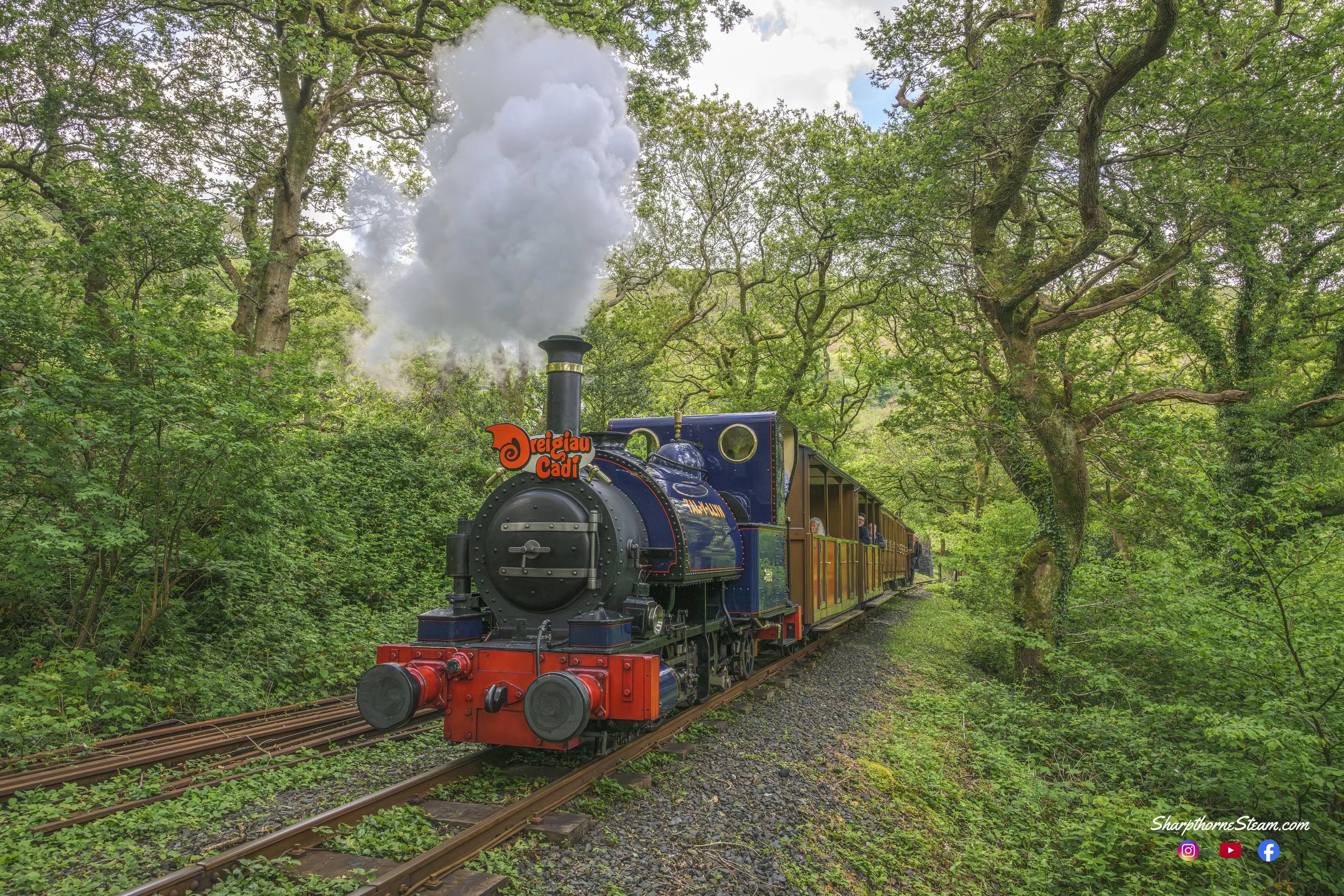
In this latest edition of the Sharpthorne Steam blog, we step into the world of narrow-gauge steam and explore why the Talyllyn Railway 75th Anniversary Gala turned out to be one of the most enjoyable events I’ve attended in quite some time. Along the way, I’ll touch on some of the unique challenges of photographing narrow-gauge steam, the quirks of shooting inside an 1860s locomotive works, and of course the usual weekend shenanigans that made this such a memorable gala.
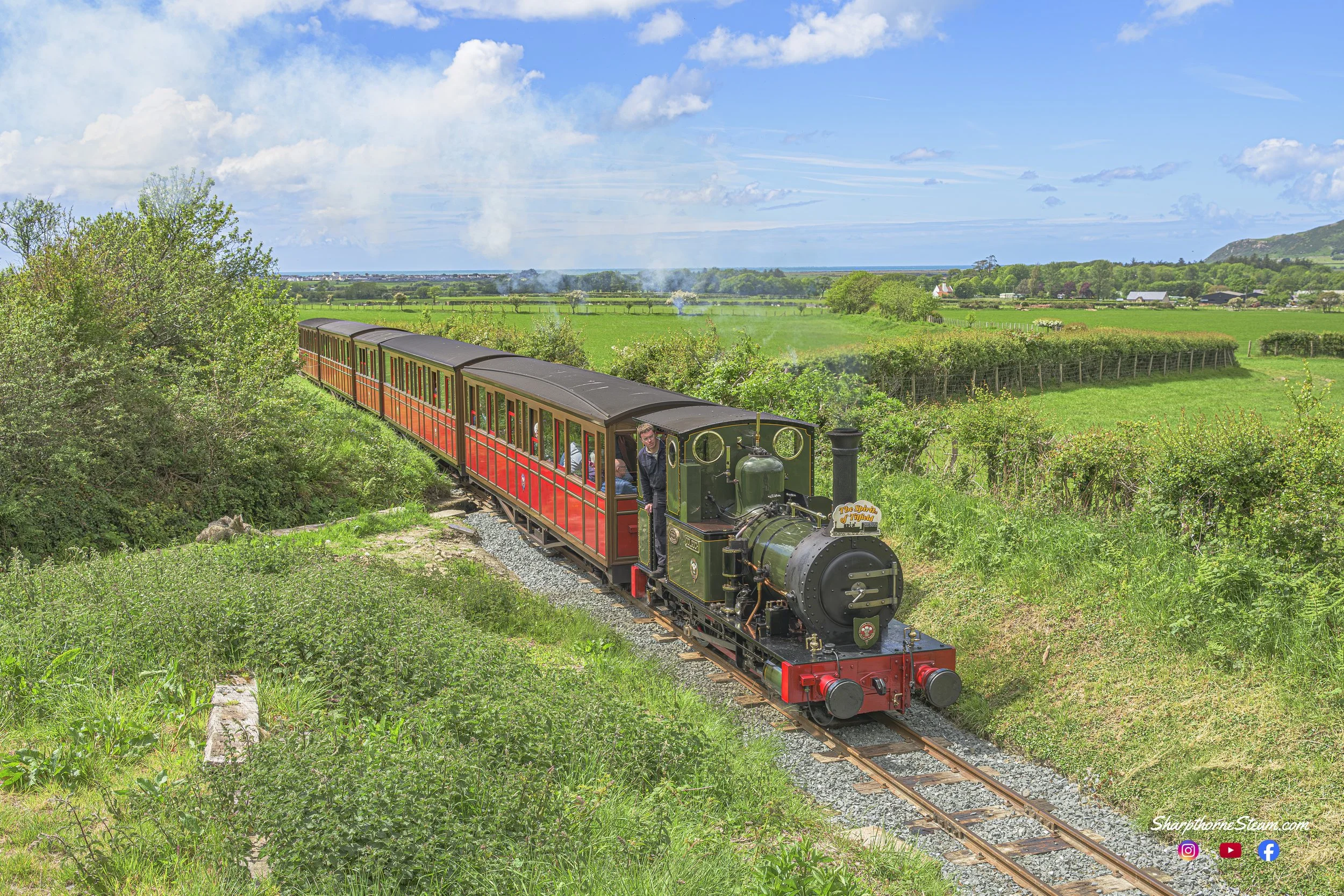
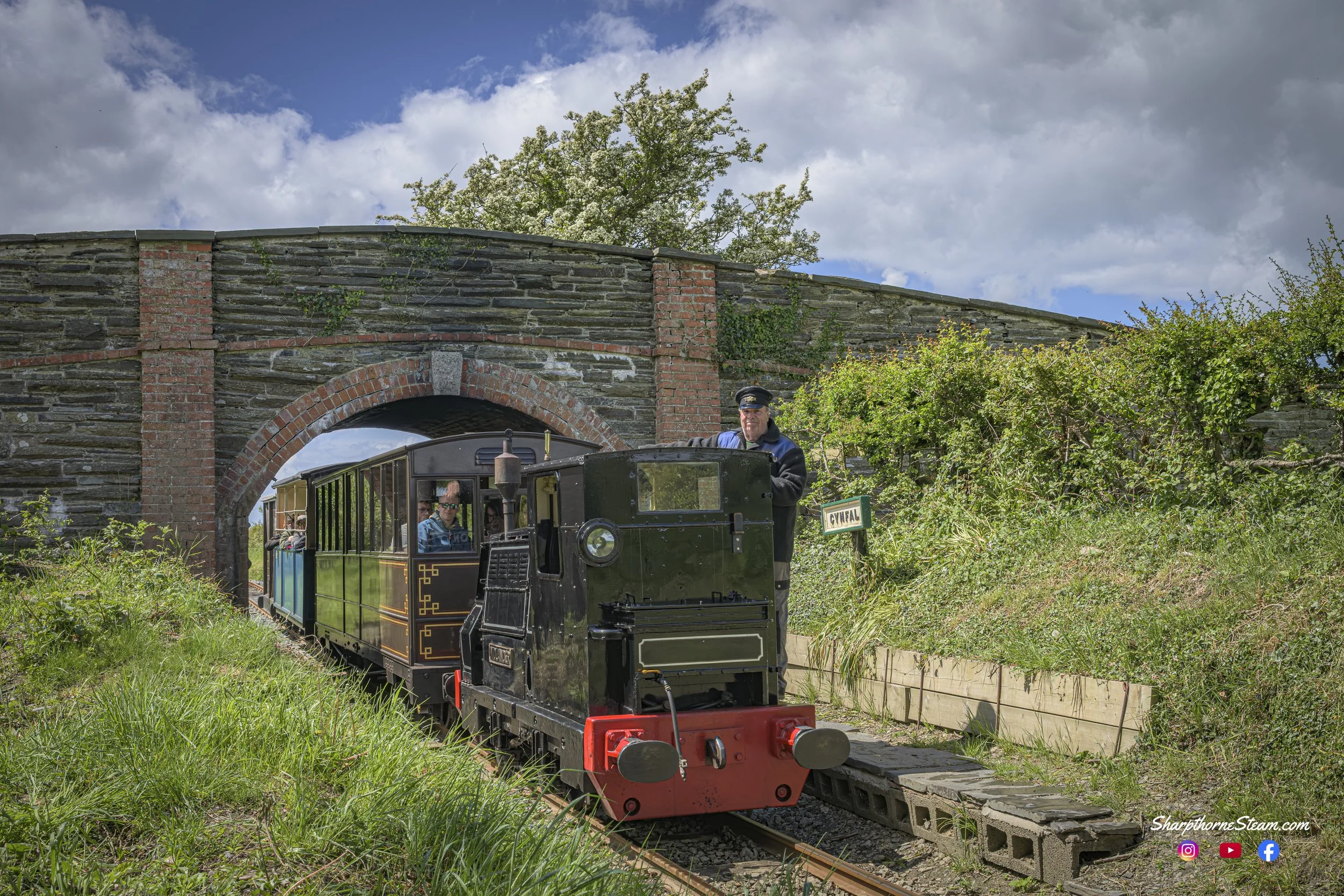
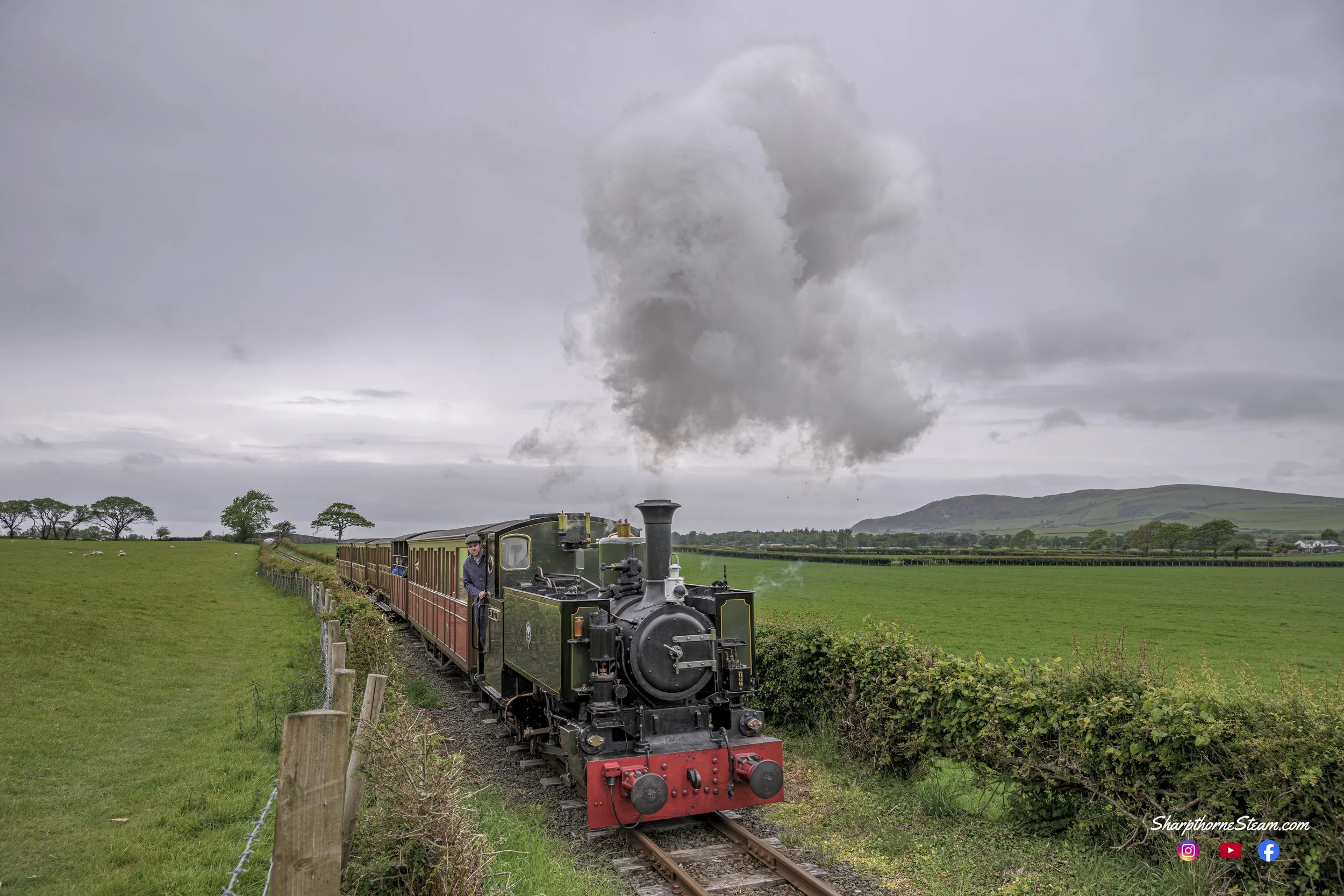
Dolgoch about to pass under Cynfal Bridge as she brings one of Friday’s trains up from Tywyn “The Spirit of Titfield”
Camera Settings: Body: Nikon Z8 Lens: Tamron 35-150mm F2-2.8 Focal Length: 35mm Shutter Speed: 1/500 Aperture: f6:3 ISO:125
My journey to the Talyllyn Railway began on a wet and windy January evening with an unexpected email from the railway inviting me to attend their 75th Anniversary celebrations. This was the first time I’d been personally invited to cover an event, and I’ll admit I hesitated. The distance was considerable, and narrow gauge isn’t exactly what I’m known for photographing or filming. I ummed and ahhed for a while, but with a conveniently empty calendar, and a growing itch to photograph narrow-gauge steam, the decision slowly became easier.
I’d heard nothing but good things about the Talyllyn. Several friends had strongly recommended a visit, including a few charter regulars who confidently told me I’d end up “catching the narrow-gauge bug”. After a bit of back and forth with Luke, Talyllyn’s media creator, I eventually thought: why not? It felt like the perfect opportunity to burst two bubbles at once, firstly, visiting another country within the UK for the first time (England aside), and secondly, properly photographing narrow-gauge steam… and diesel (with diesel videos coming later in September, when the channel becomes Sharpthorne Diesel).
With the distance involved, preparation was key. I didn’t want to waste any opportunities, so I did what any sensible railway photographer should do when approaching a new line: take a virtual ride. I spent time studying the route, identifying locations that caught my eye, and cross-referencing them with Google Maps. Another invaluable resource was working through existing photo libraries. Huge thanks go to @amsbusandtrain and @lgkphotography, whose extensive and inspiring Talyllyn collections played a big part in convincing me that this trip would be worth every mile.
Friday
Friday was the day I was most looking forward to, primarily because I suspected it would offer the best photographic opportunities of the three, mainly due to sun being forecast. From the outset, I knew I wanted to begin at Dolgoch Falls. Although I was aware I’d be working on the “dark side” of the line, I hadn’t fully appreciated during my research just how many of my planned locations would be affected by this. It wasn’t until later, after chatting with several seasoned linesiders, that I learned this is largely just the nature of photographing railways in Wales.
We arrived at Dolgoch Falls with my first target firmly in mind: the viaduct. It’s very much a signature shot of the Talyllyn Railway, and with a good weather forecast throughout the day, the plan was simple, cover as much ground as physically possible and come away with a varied selection of images. Joining me for the weekend was @miketraintravel, who was keen to experience the fast-paced, location-hopping style of photography that now comes far more naturally to me than it ever did when I first started out.
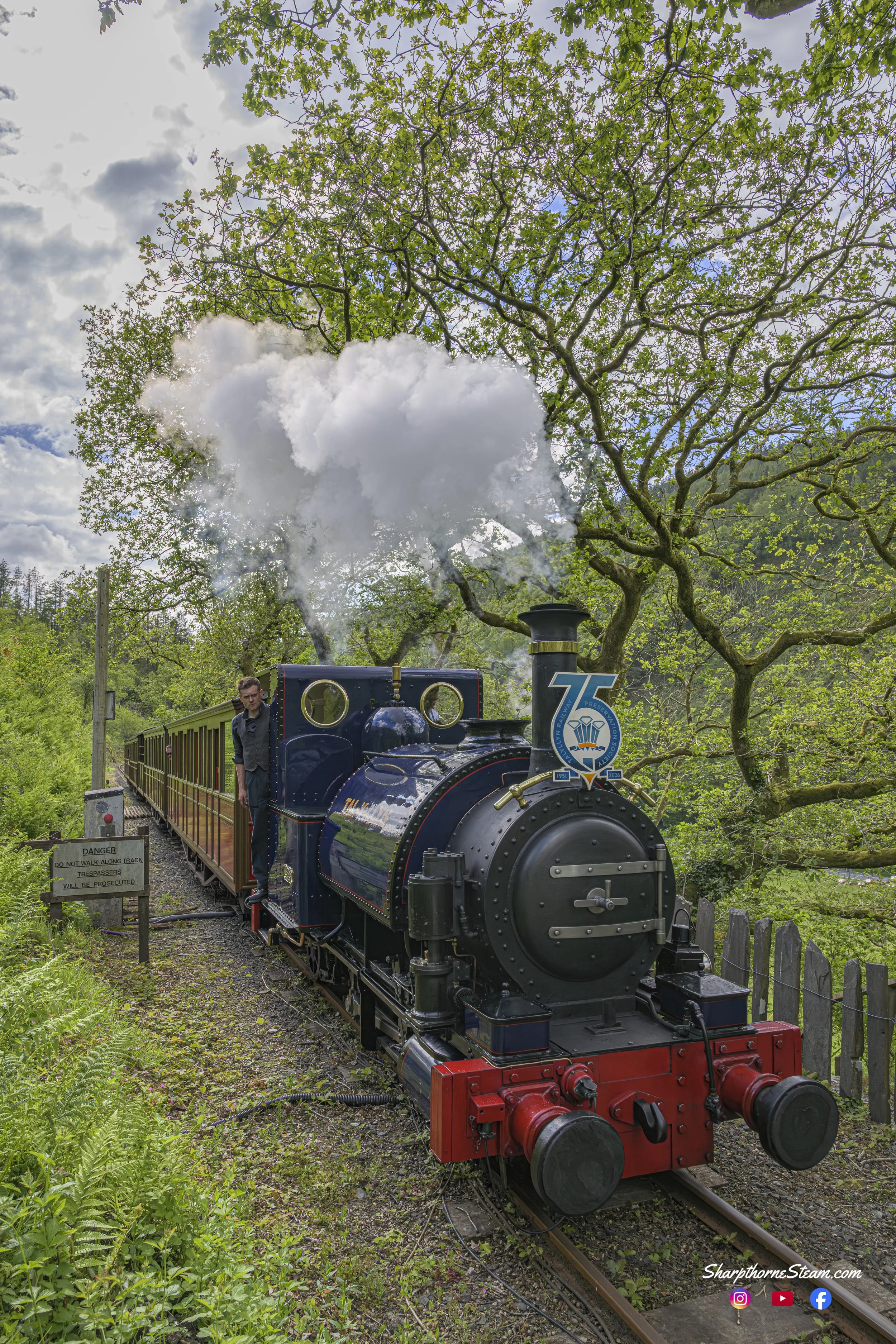
The first working of the day featured No.4 Edward Thomas. Named after one of the four men who took over the railway from Sir Henry Haydn Jones, who famously saved the line in 1910, the locomotive was built by Kerr Stuart & Co in 1921 and has served on the Talyllyn since 1951.
For this event, I reverted to an older workflow: the camera dedicated solely to stills, with video handled on my phone. With tight, enclosed vistas along the line, the camera spent just as much time in portrait orientation as it did in landscape. As this was my first proper outing photographing narrow-gauge steam, I was still trying to find a rhythm that worked for me, and it quickly became apparent that I had plenty left to learn, something the very next shot would make abundantly clear.
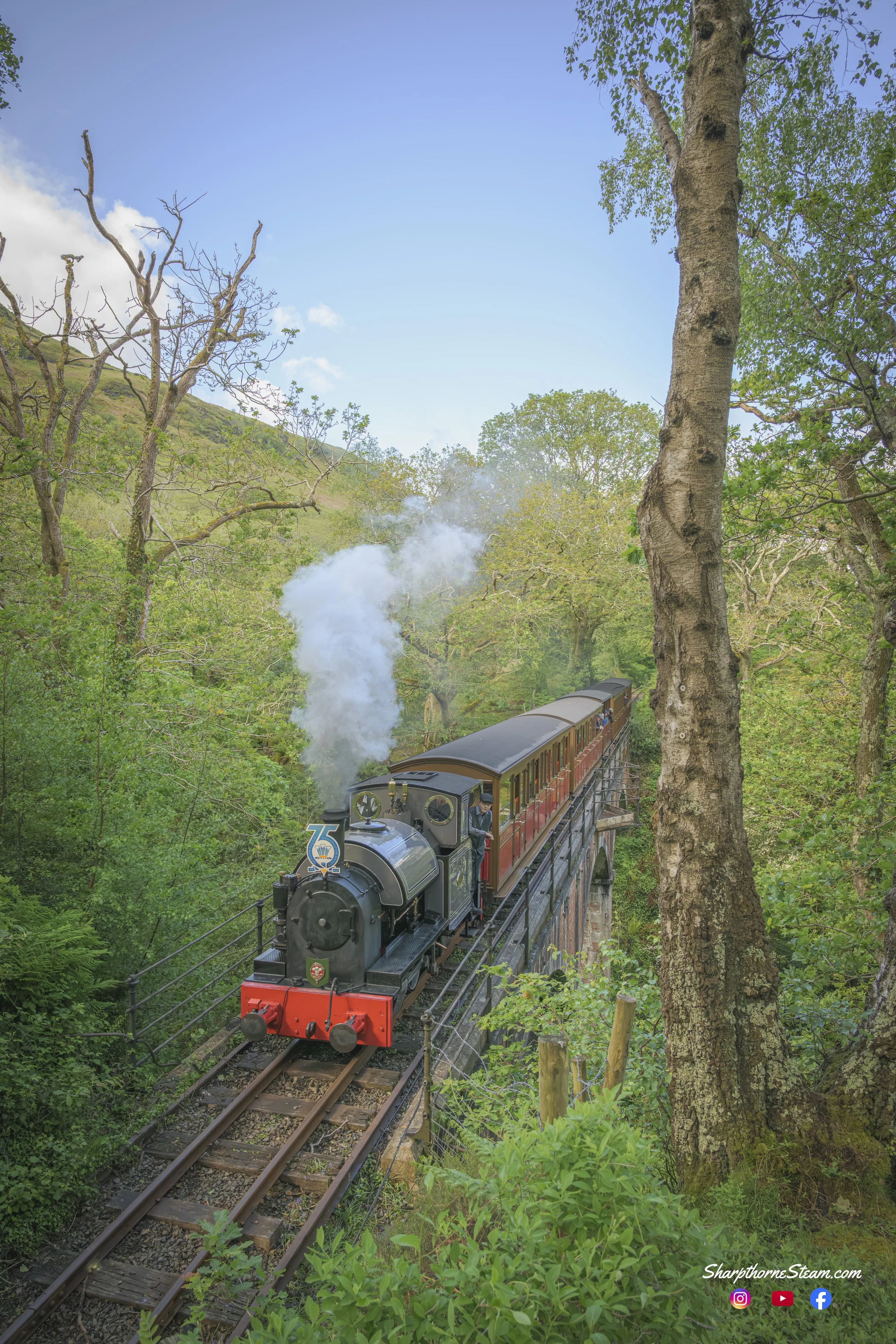
The First Shot - No4 “Sir Thomas” starts the weekend off proudly displaying the Talyllyn Railway crest and 75th headboard
Camera Settings: Body: Nikon Z8 Lens: Nikkor Z 24-70 f4 Focal Length: 26mm Shutter Speed: 1/320 Aperture: f6:3 ISO: 400
Having spent most of my time photographing standard-gauge locomotives, I initially found it surprisingly difficult to get to grips with the smaller scale of narrow gauge. After a scenic walk across the hills from Dolgoch to Quarry Sidings, we reached a crossing where I promptly made my first mistake of the weekend: underestimating just how compact these lovely locomotives really are.
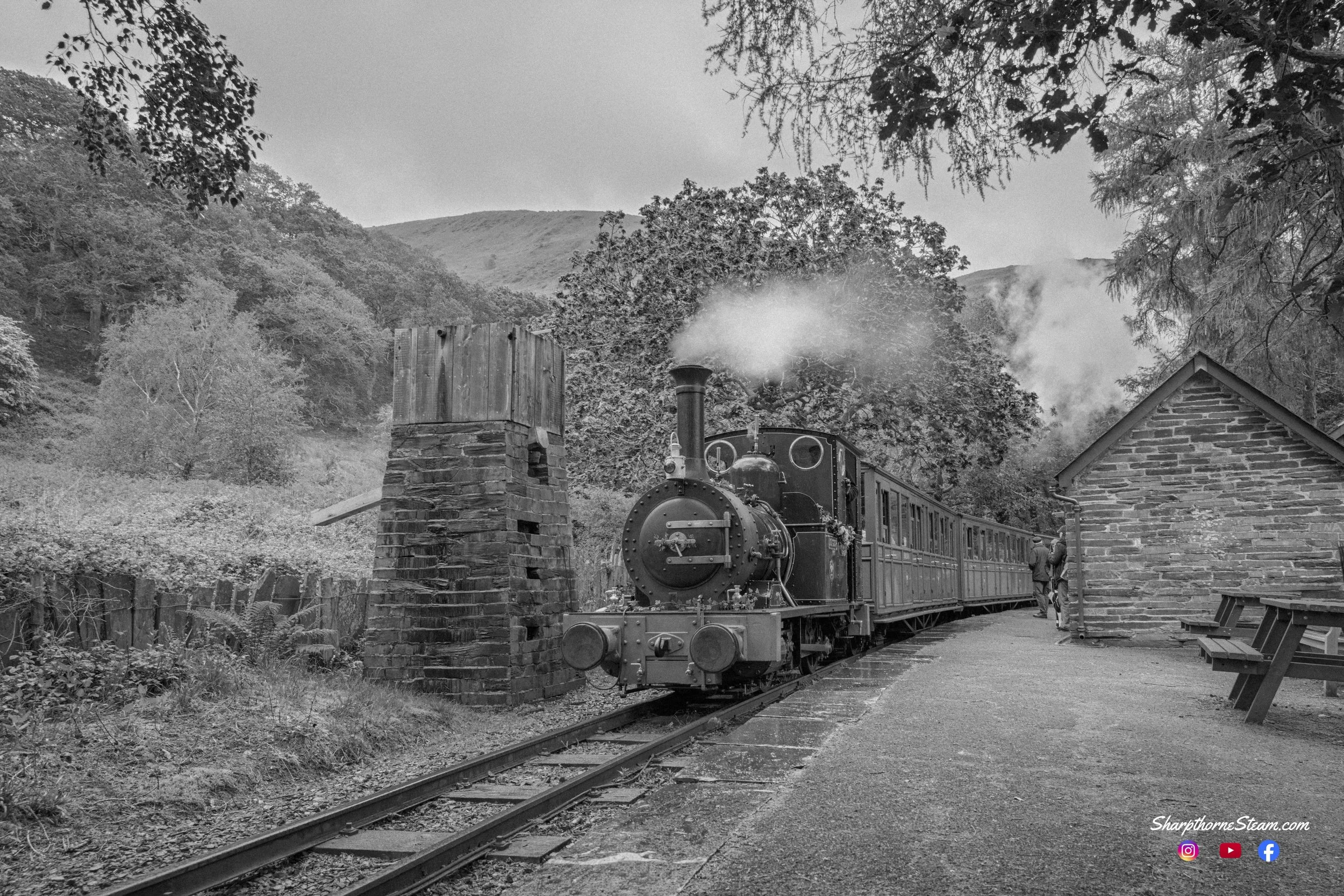
The engine in question was No.1 Tal-y-llyn, the oldest locomotive in the fleet, built in 1864, making it one of the oldest locomotives I’ve ever photographed. Unfortunately, one of a linesider’s oldest enemies made a timely appearance: the fern. With the mild weather, everything had already started to grow, and the vegetation was beginning to encroach on otherwise promising compositions. I tried kneeling to avoid shooting down on the locomotive while keeping the rolling hills in the background, but that decision cost me any chance of including the running gear. Lesson learned.
Technical callout – Quarry Sidings crossing
Lens: mid-range zoom
Focal length: ~24-70mm equivalent
Positioning: Low, kneeling position to reduce shooting down on the locomotive
Takeaway: Narrow gauge needs either more distance or a lower camera height to avoid losing proportions—watch foreground vegetation carefully
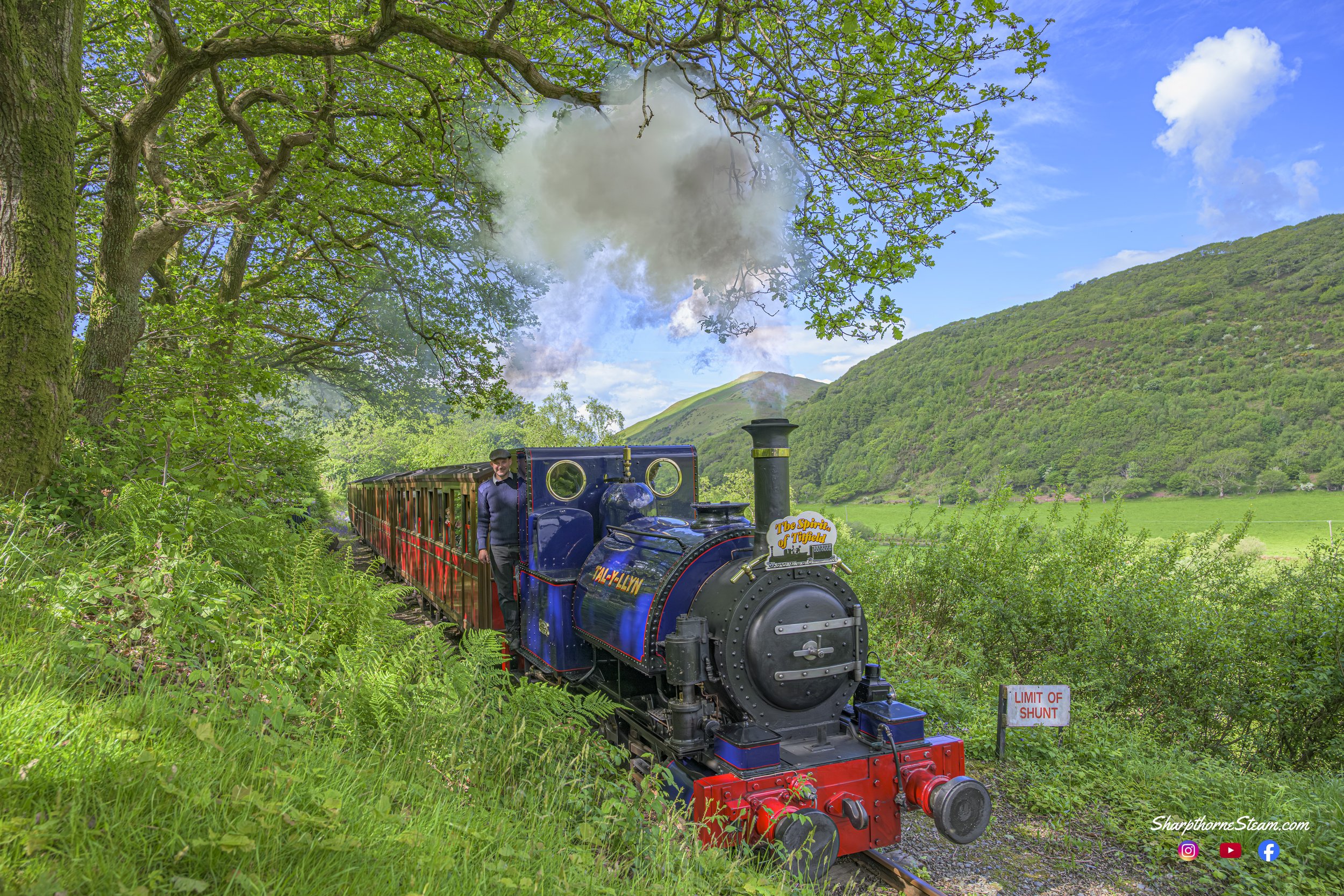
Height is key - No1 Talyllyn climbs towards Quarry Sidings with the first “The Spirit of Titfield” train of the Friday
Camera Settings: Body: Nikon Z8 Lens: Nikkor Z 24-70f4 Focal Length: 24mm Shutter Speed: 1/400 Aperture: f6:3 ISO:320
With that firmly noted, I reassessed my locations and decided to head further down the line to Rhydyronen and Cynfal to get onto the right side of the sun.
The next photograph was taken just beyond Rhydyronen and featured No.3 Sir Haydn, built in 1878 by Hughes Locomotive & Tramway Engineer Works. This was a shot I wanted in landscape format, with Tywyn visible in the distance. It was here that I reacquainted myself with Andrew (@amsbusandtrain), who quickly became our unofficial guide for the weekend, huge thank you to him for the location advice throughout.
Sir Haydn looked superb as she passed Cynfal Halt and headed towards Rhydyronen. The scenery along this line is exceptional, and I made a conscious effort to incorporate as much of it as possible. The field just west of Rhydyronen proved particularly productive, with the sun doing much of the heavy lifting. I spent several hours there experimenting with viewpoints around the halt, the bridge at Cynfal, and multiple angles from within the field.
Technical callout – Rhydyronen Field / Cynfal Halt/Bridge
Lens: Mid-range zoom
Focal length: ~35–150mm & 24-70mm for the halt
Orientation: Landscape
Positioning: Slightly elevated ground in the field, shooting across the valley
Takeaway: Narrow gauge suits wider focal lengths—let the landscape tell the story
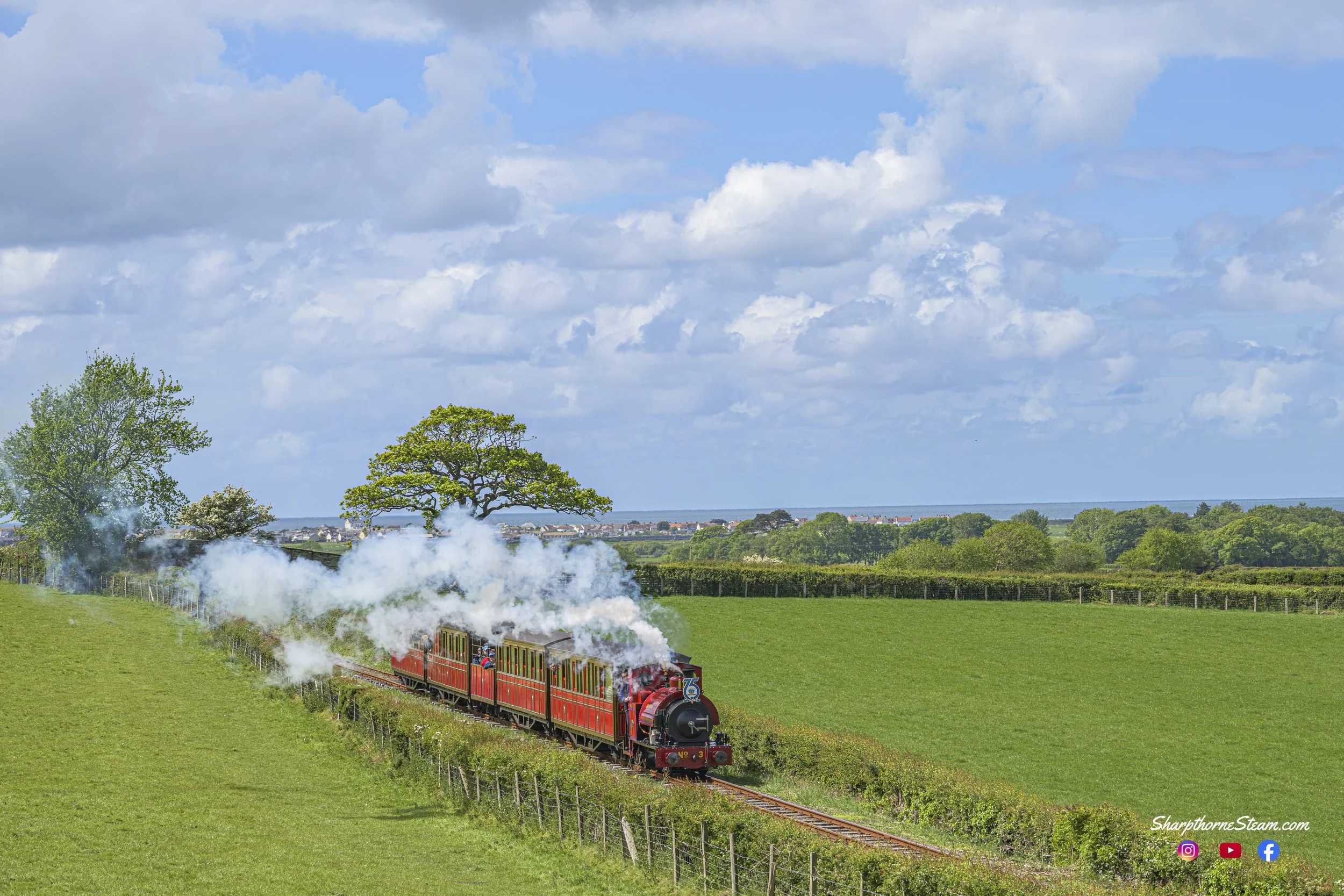
Right side of the Sun - No 3 passes through the field just before Rhydyronen heading towards Newt Gwernol
Camera Settings: Body: Nikon Z8 Lens: Tamron 35-150mm F2-2.8 Focal Length: 100mm Shutter Speed: 1/400 Aperture: f8:0 ISO:100
My primary focus for the weekend was photographing the Coronation Special, recreated by the Talyllyn Railway as part of Friday’s 1950s themed operations. Each day of the gala represented a different era: Friday covered the 1950s–60s, Saturday the 1970s–80s, and Sunday the 1990s through to the present day, allowing for multiple historical recreations.
With limited prior knowledge of the line, I used earlier services to test locations before committing to key shots. For the Coronation Special, I wanted to be close enough for the headboard to dominate the frame. Cynfal felt ideal, allowing me to use the bridge as a natural frame while working in landscape orientation
Technical callout – Coronation Special at Cynfal
Lens: Mid-range zoom
Focal length: ~24-70mm
Orientation: Landscape
Positioning: Use the bridge as framing to get more exhaust swirling around the loco in shot
Takeaway:
There was a fantastic amount of exhaust as the train approached, but we were slightly taken aback when it unexpectedly came to a halt, despite being a halt, we hadn’t yet seen anyone use it. That mystery was quickly solved when @therailwayrambler made one of his now-trademark surprise appearances, stepping off and leaving the rest of us chuckling as the train moved on with Owen standing alone on the platform. He certainly knows how to make an entrance.
It was also around this time that Luke, apparently armed with laser vision, even through glasses, spotted my camera bag and introduced himself. It was great to finally thank him in person, and I’ll repeat that thanks here, not just to Luke but to every volunteer involved. The weekend was a warm, friendly, and wonderfully organised celebration of “The Railway with a Heart of Gold”, and I genuinely felt at home from start to finish.
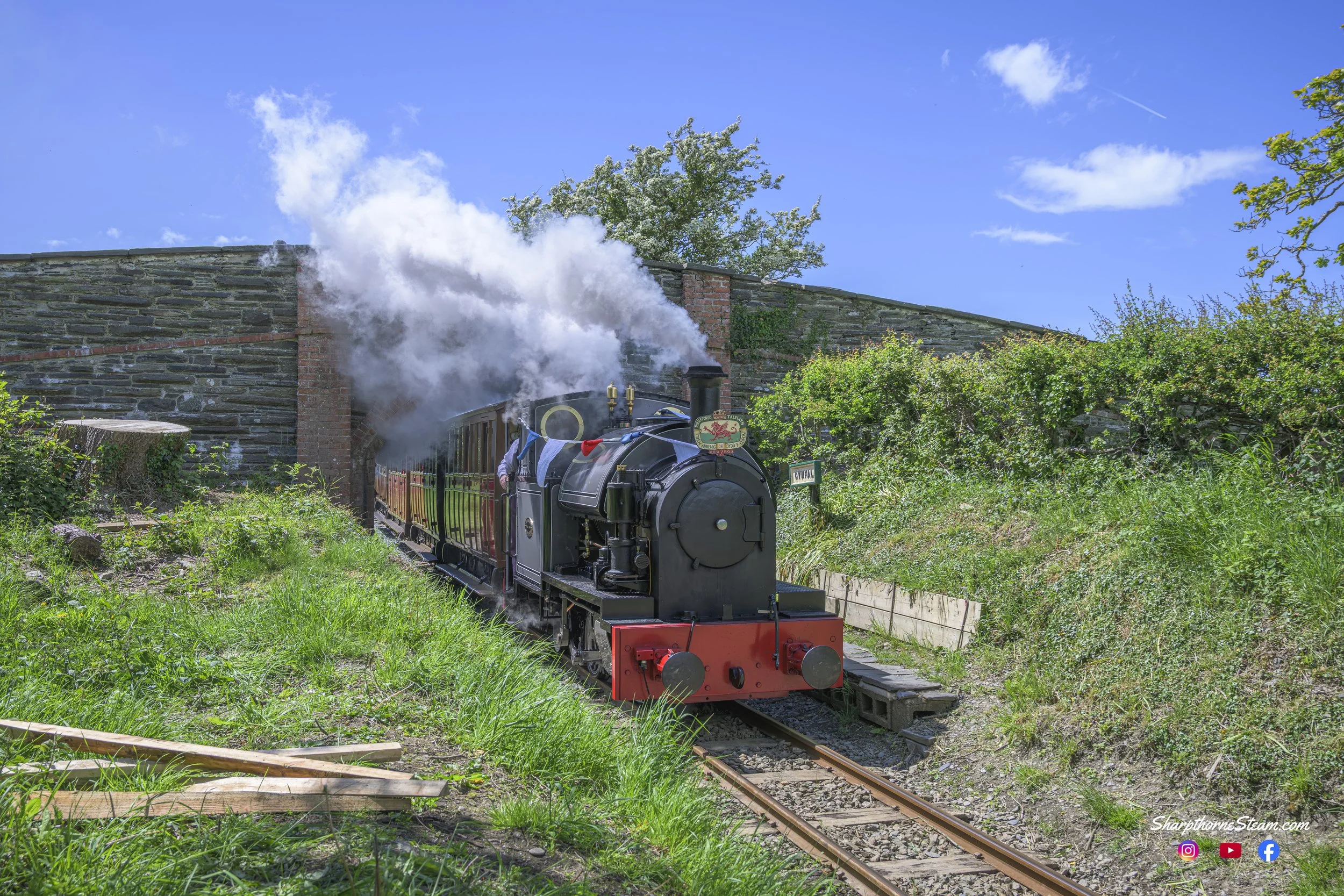
Up Close with Royalty - No4 with the Coronation Special pulls into Cynfal Halt with a representation of the train that hauled the Coronation Special back in 1953
Camera Settings: Body: Nikon Z8 Lens: Nikkor Z 24-70f4 Focal Length: 32mm Shutter Speed: 1/500 Aperture: f6:3 ISO:125
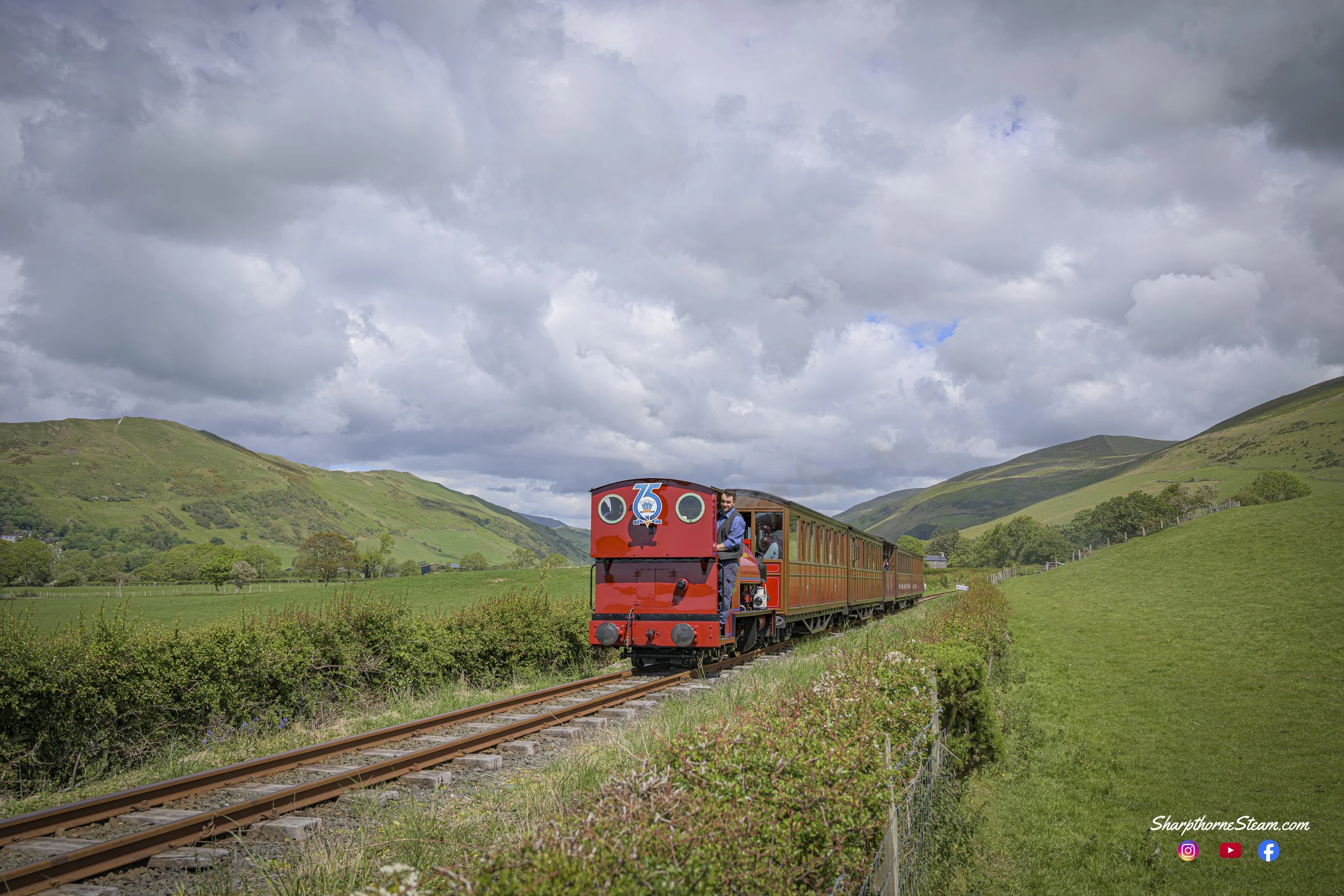
From there, I tried something I don’t often do: a cab-first shot. Normally I’d avoid it, but the scenery was simply too good to ignore. With fluffy clouds building and the hills forming a perfect backdrop, the shot was impossible to pass up. A dead section of hedge, discovered with the help of my trusty steps, allowed me to include even more of the landscape, particularly the hills off to the right.
Technical callout – Cab-first experiment
Lens: Short telephoto
Focal length: ~24mm
Positioning: Slightly off to the side, using steps to gain height
Takeaway: Don’t rule out cab-first shots on narrow gauge, context and scenery can carry the image
It was here that Sharpthorne Steam briefly exited the chat and Sharpthorne Diesel made an appearance. With a diesel-themed weekend planned for September when the Bluebell Railways diesel gala is on, I took the opportunity to gather some photo and video footage. Annoyingly, this turned out to be one of my favourite photos of the weekend. The light was spot-on, the edit was effortless, and even the sheep in the field seemed keen to play their part. What started as a trial-and-error practice shot ended up being a standout image for me. No.5 Midlander would, in fact, be my only diesel photograph of the Talyllyn until Sunday morning. I generally prefer filming diesels rather than photographing them, mainly for the sound, but this one certainly proved me wrong.
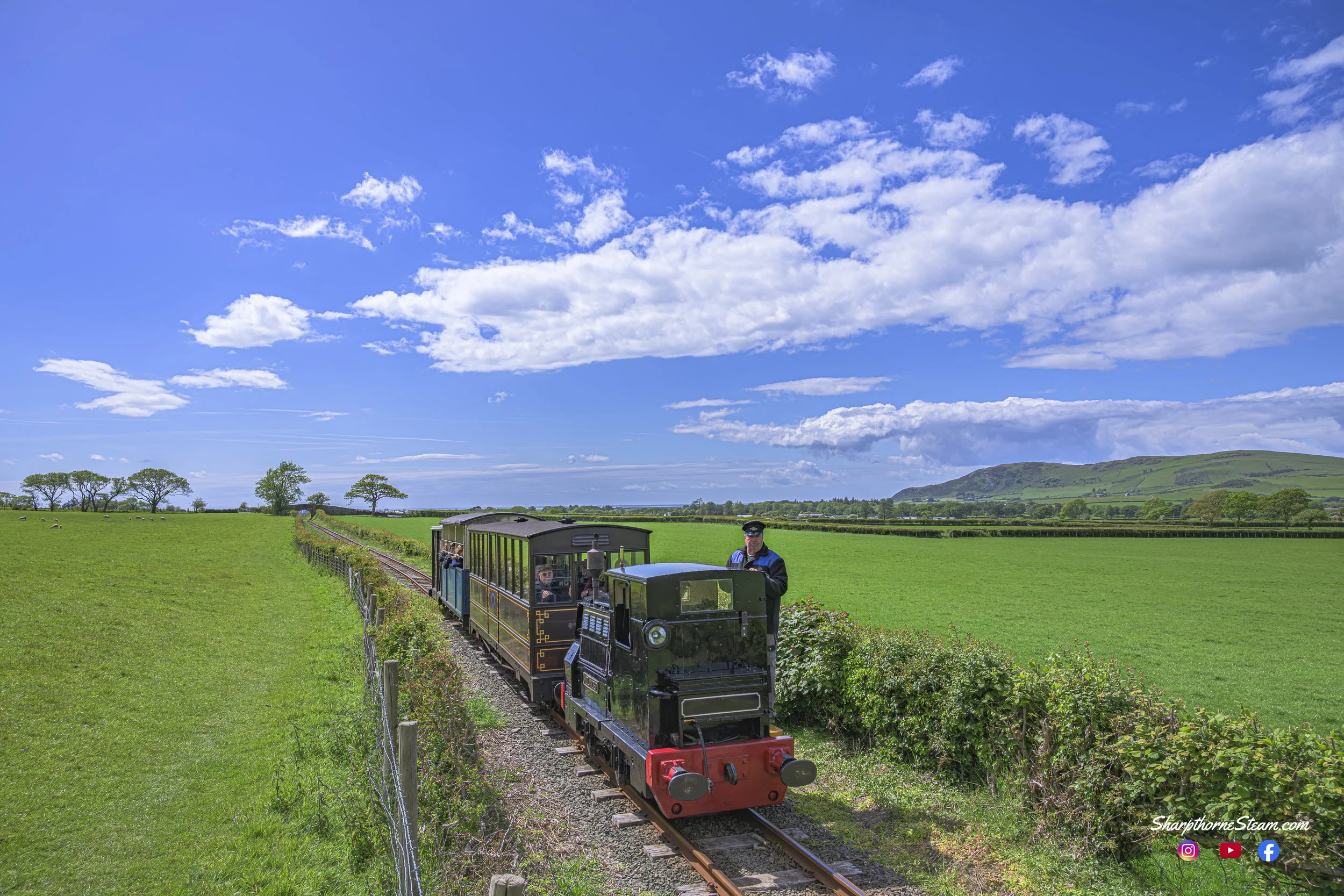
The Midlander - No 5 “Midlander” is seen descending into Rhydyronen with a market train
Camera Settings: Body: Nikon Z8 Lens: Nikkor Z 24-70f4 Focal Length: 24mm Shutter Speed: 1/500 Aperture: f7:1 ISO:80
After Rhydyronen, we moved further up the line to Abergynolwyn to investigate Forestry Crossing, once again with Tal-y-llyn leading. This was where the light began to get interesting, transitioning from one side of the line to the other. In some cases, that meant shooting directly into the sun with trees in frame, a perfect opportunity to further familiarise myself with Lightroom’s de-fringe tool.
I also tried a spot just along the path from Abergynolwyn, where the line straightens slightly and offers a useful angle, ideal for a double-header, particularly with Dolgoch involved. By this point, the sun was starting to peek through the nearby trees, and with the help of my steps, I worked hard to capture a frame that used the sunlight to add something a little different to the image.
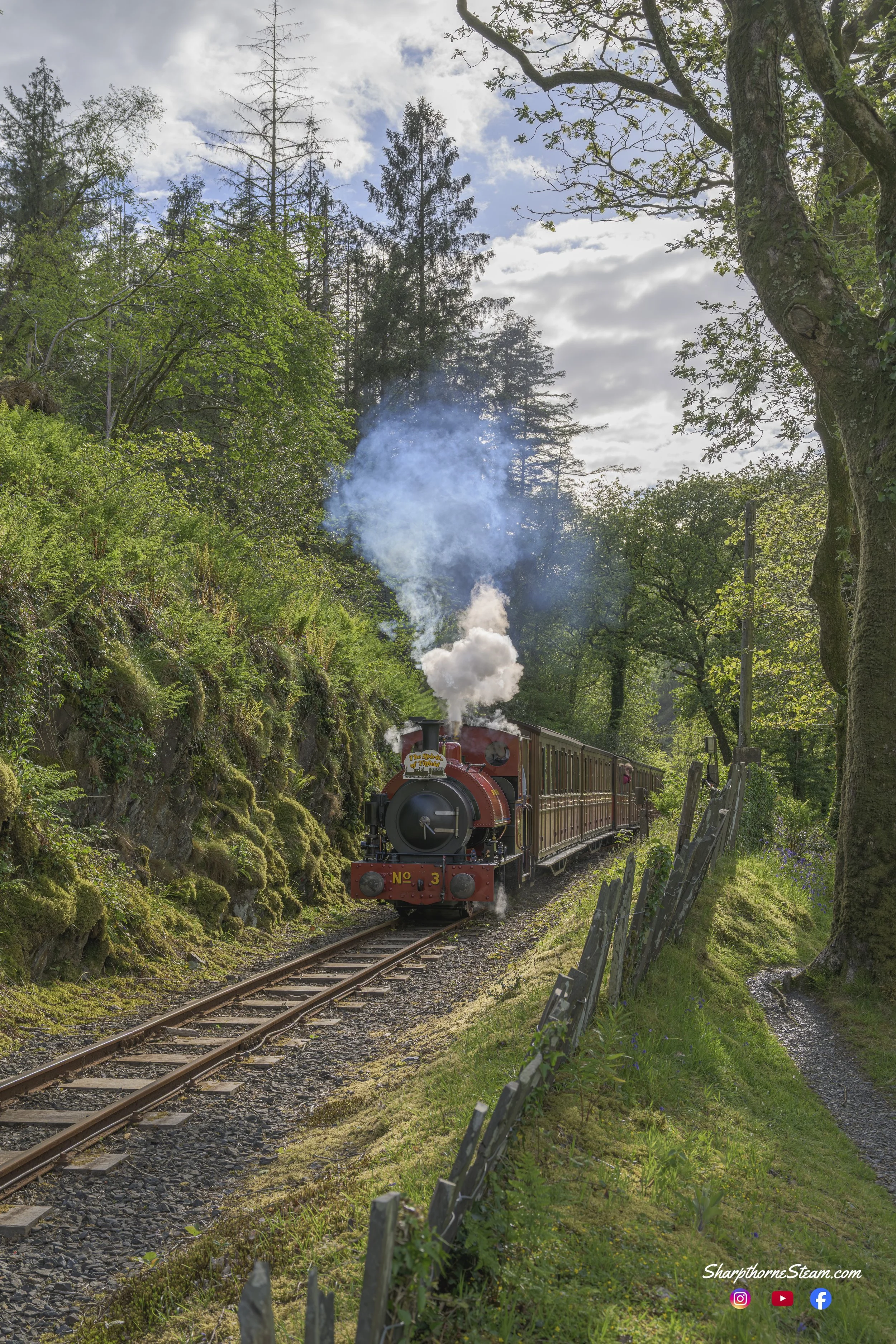
Whistle While You Work - No3 leaves Abergynolwyn with the last “The Spirit of Titfield” train of the Friday
Camera Settings: Body: Nikon Z8 Lens: Nikkor Z 24-70f4 Focal Length: 45mm Shutter Speed: 1/500 Aperture: f6.3 ISO:125
With Friday wrapped up, it was time to head back to the chalet and prepare for what was forecast to be a rather damp Saturday. As it turned out, Saturday would deliver plenty of twists and turns of its own, especially as the evening drew on.
Saturday
We began Saturday morning with a video shot of Alf at Dolgoch Falls, before heading back to Quarry Sidings for another attempt with No.5 on the coal train. By this point, however, the light had noticeably faded and was far flatter than the glorious conditions we’d enjoyed on Friday. I found myself time-watching, as I often do at events like this—because the next working I really didn’t want to miss was the Extension Opening Special.
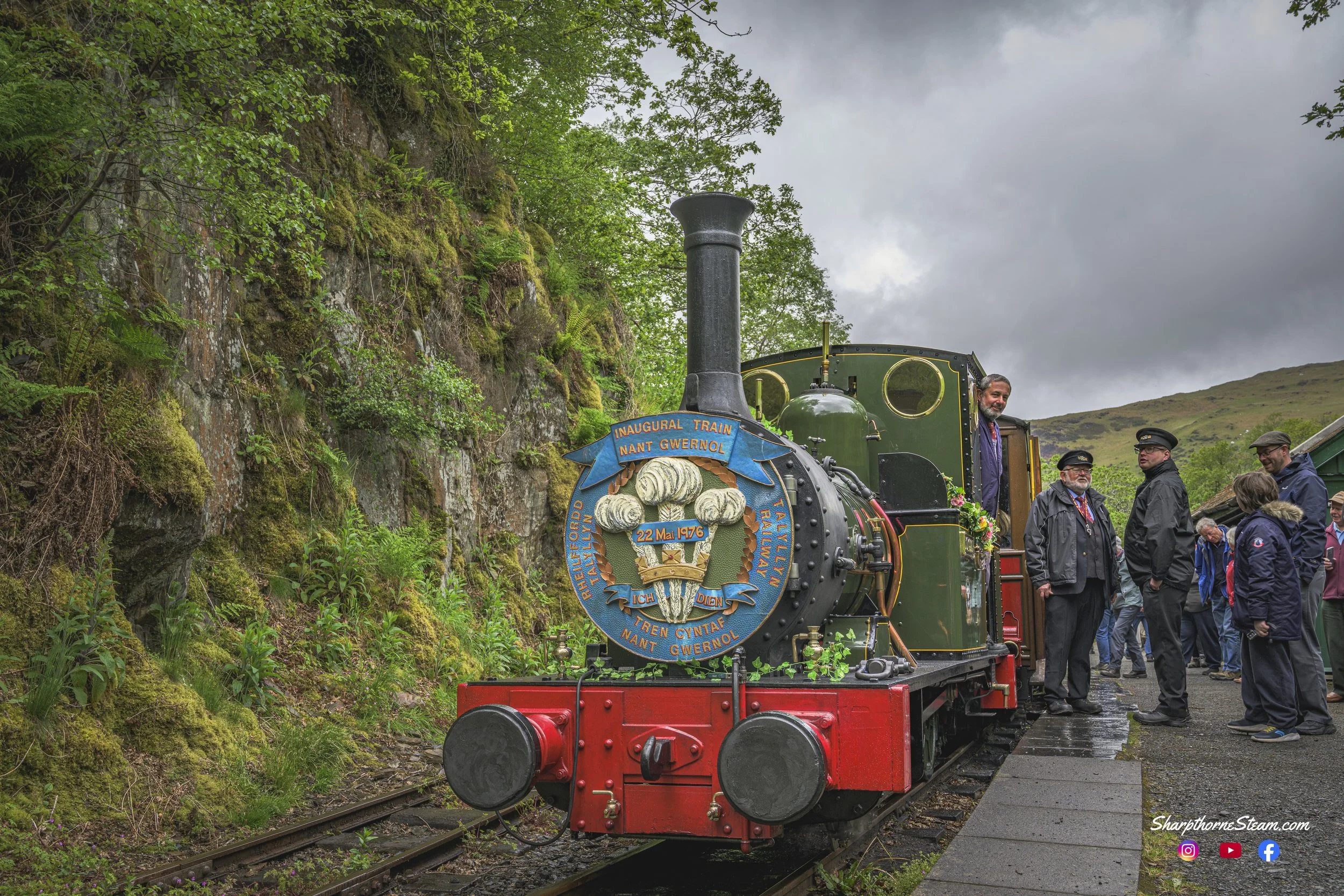
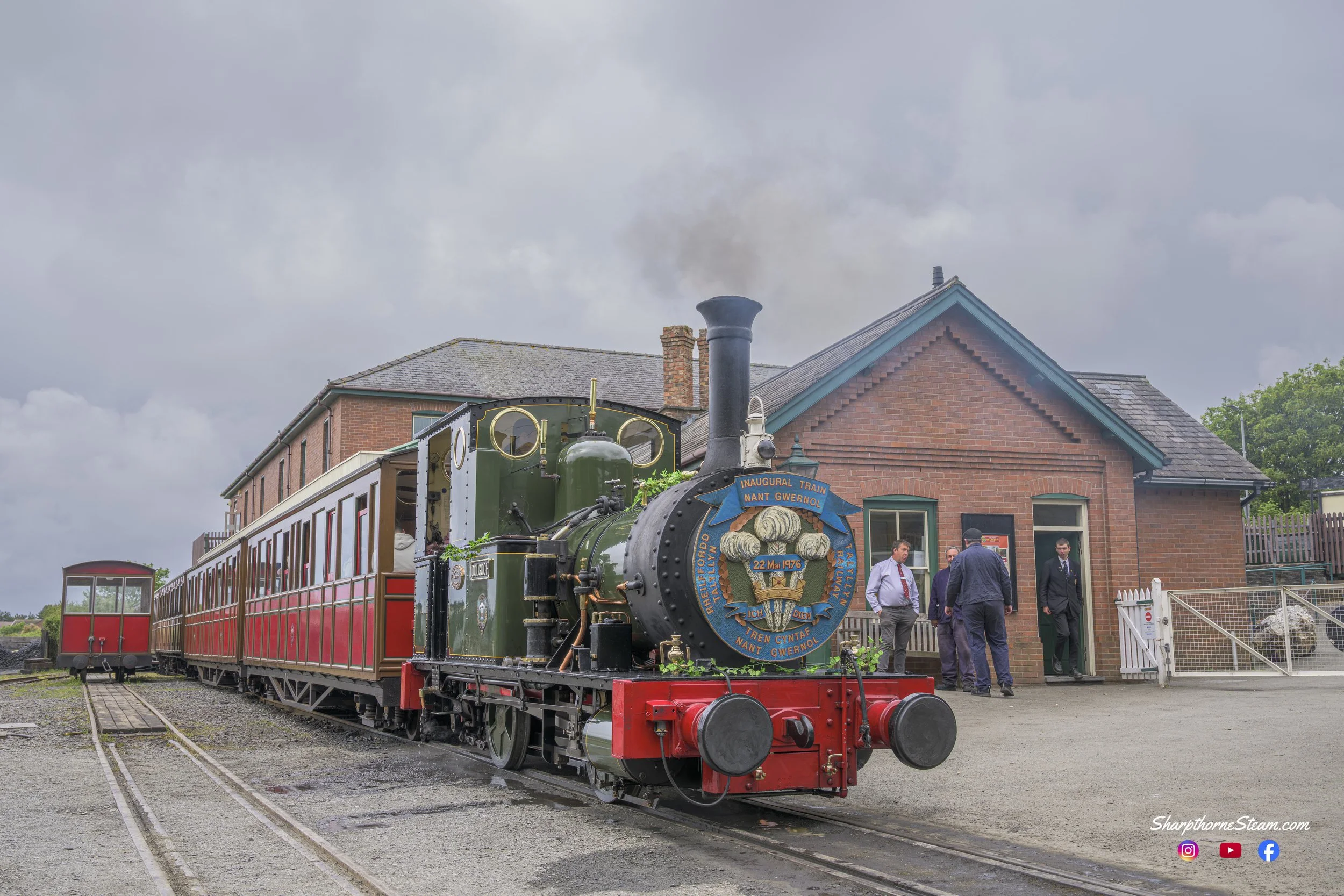
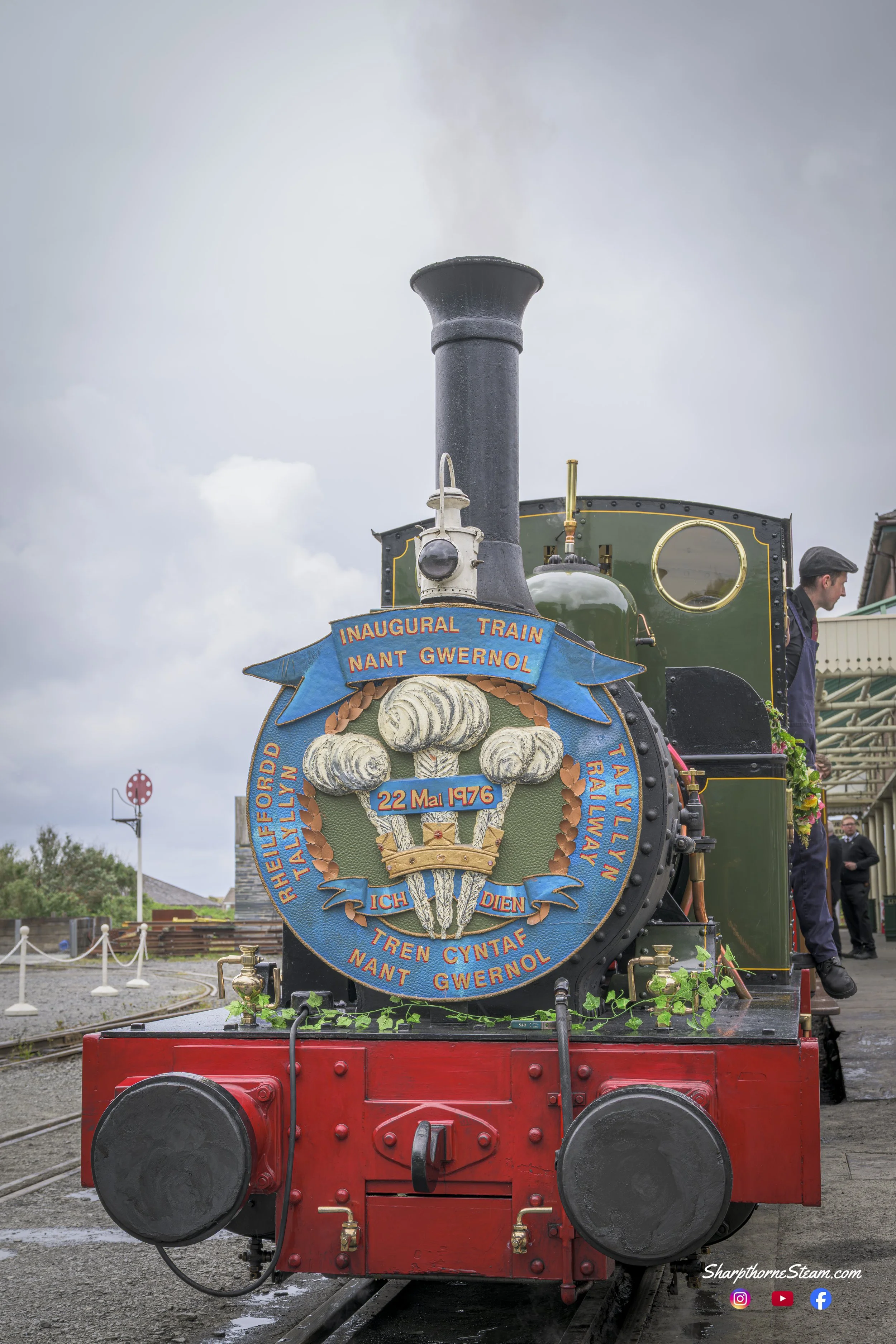
We travelled the full length of the line down to Tywyn Wharf, arriving at 10:55 for an 11:05 departure. When we got there, the locomotive wasn’t yet carrying its headboard, which, as it turned out, was fortunate. What followed was one of the most enjoyable and relaxed photo sessions of the weekend, featuring one of the best headboards I’ve ever seen.
The light blue colour worked beautifully with my Nikon colour recipe and absolutely popped against the locomotive, even under dull skies. This was the original headboard from 22 May 1976, and being extremely fragile, there was a collective hope that the rain would hold off long enough for everyone to enjoy photographing a genuine piece of history. A number of photographers gathered on the platform, and we all performed the familiar dance, politely shifting, crouching, stepping aside, each of us chasing our own version of the perfect shot. The grey, overcast light actually helped here, allowing the headboard’s vibrant colours to stand out even more.
Technical callout – Tywyn Wharf headboard session
Lens: Mid-range zoom
Focal length: ~24-50mm
Positioning: Platform-level, square-on and also quarter view of locomotive
Lighting: Flat overcast—ideal for colour saturation of the headboard
Takeaway: Dull light can be perfect when colour is the subject
I was originally meant to be on the train, but after losing Mike in the crowd, I decided to stay behind and watch Dolgoch depart on the first leg of her journey—minus headboard. The headboard itself would be travelling in style in first class, reappearing later at Nant Gwernol, giving us another photographic opportunity. After regrouping with Mike, we drove to Dolgoch to catch the train once more, this time finally using our tickets for the first time all weekend.
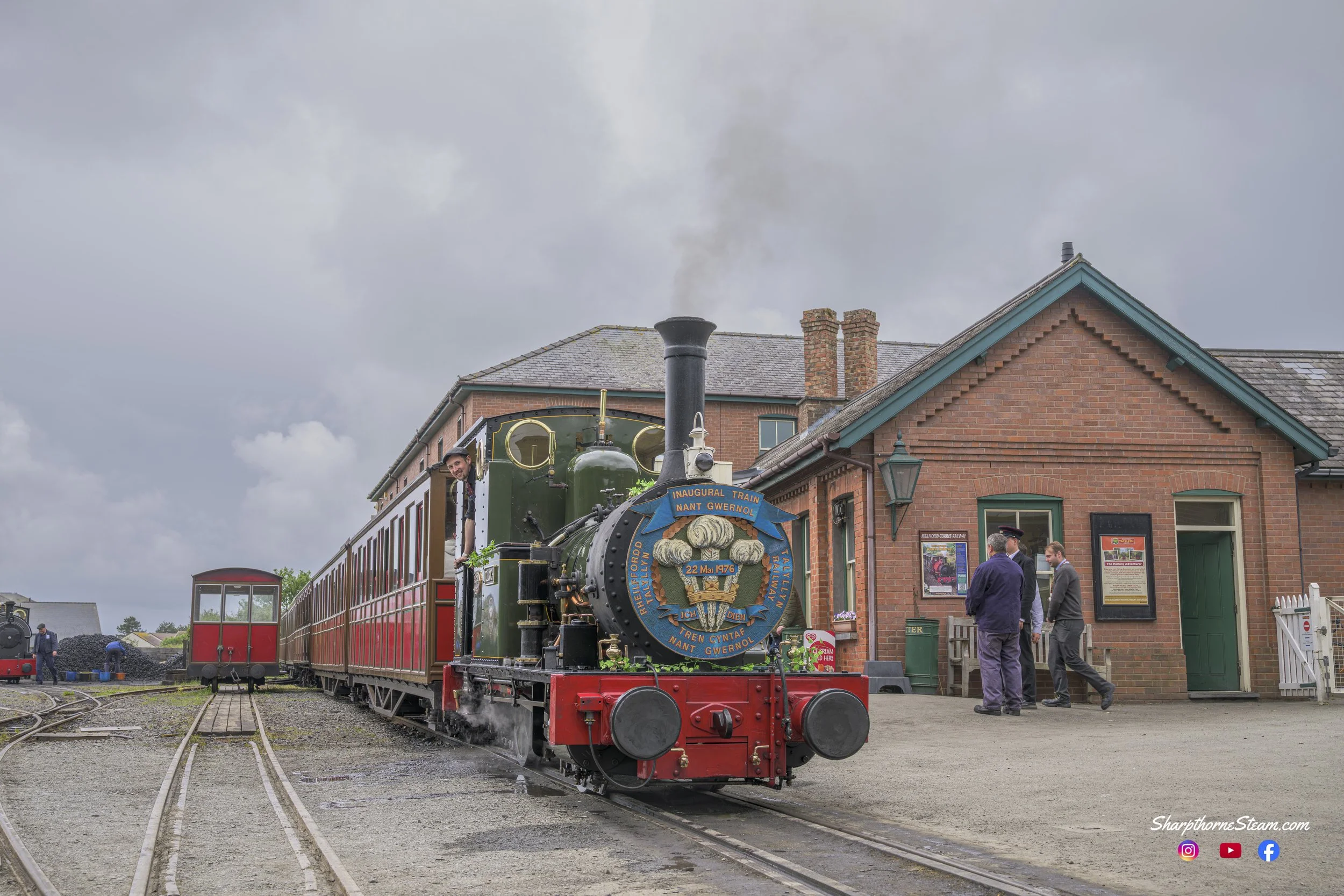
Extension Special - No 2 “Dolgoch” prepares to leave Tywyn Wharf with the extension special on Saturday morning
Camera Settings: Body: Nikon Z8 Lens: Nikkor Z 24-70f4 Focal Length: 39mm Shutter Speed: 1/160 Aperture: f6.3 ISO:80
With Nant Gwernol ticked off, we re-boarded the train and travelled back down to Rhydyronen, positioning ourselves for the much-anticipated double-header involving Tal-y-llyn and Dolgoch. Unfortunately, by now the rain had firmly set in. Having recently watched my Z8 take an unwanted soaking at the West Somerset Railway, I made the decision to keep it tucked safely under my waterproof coat and use my phone for video and get the camera out at the very last moment.
Originally, I’d planned to film the double-header using a long lens, as the straight at Cynfal Bridge really lends itself to that approach. In the end, instinct took over and I reverted briefly to old-school Sharpthorne Steam—whipping the lens cap off the Z8 just in time to grab a still as the pair stormed over the bridge. Unfortunately, the wind was blowing towards the camera, the challenge was keeping most of the rain off the lens.
Technical callout – Cynfal Bridge double-header
Lens: Telephoto zoom
Focal length: ~24-300mm
Positioning: Either centre of the bridge for long focal length shot or to the left of the bridge for a closer shot
Weather strategy: Camera sheltered until final moments
Takeaway: Sometimes one well-timed still beats a full video clip
I then headed further up the line to revisit the spot where I’d photographed Midlander the previous day, hoping to salvage something in the dull light with No.7 Tom Rolt—a locomotive I share my birth year with. Built at the Talyllyn Railway itself, she sounded like she was doing 100mph as she thundered towards the camera, clearly making up time as she flew past.
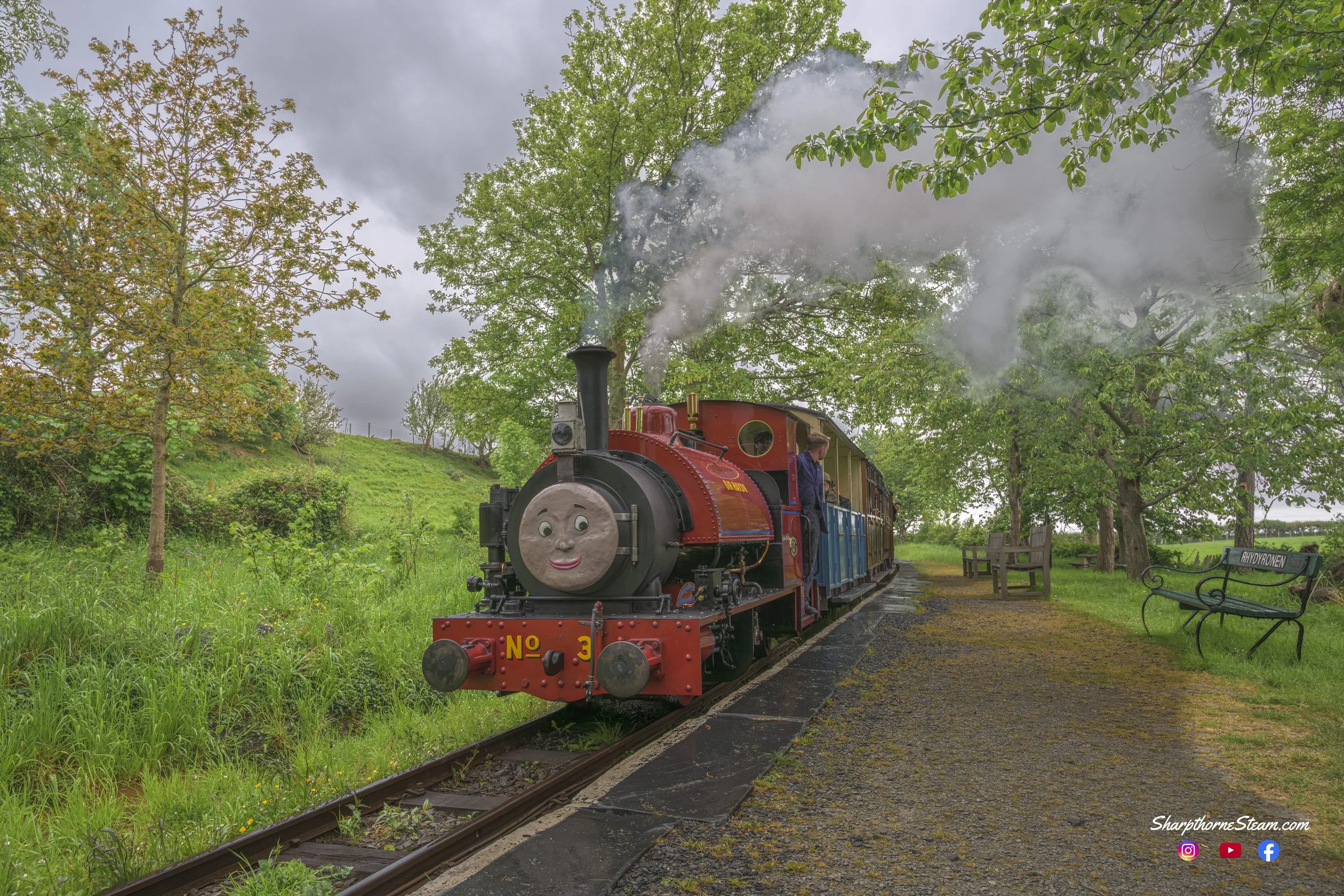
We managed one final daylight shot at Rhydyronen, this time with No.3 Sir Haydn sporting an Awdry Special face in homage to the creator of Thomas the Tank Engine. From there, we boarded the double-header of Tal-y-llyn and Dolgoch and headed south for my first proper experience of the line between Rhydyronen and Tywyn Wharf—unaware at the time that I wouldn’t be heading north again until well after nightfall.
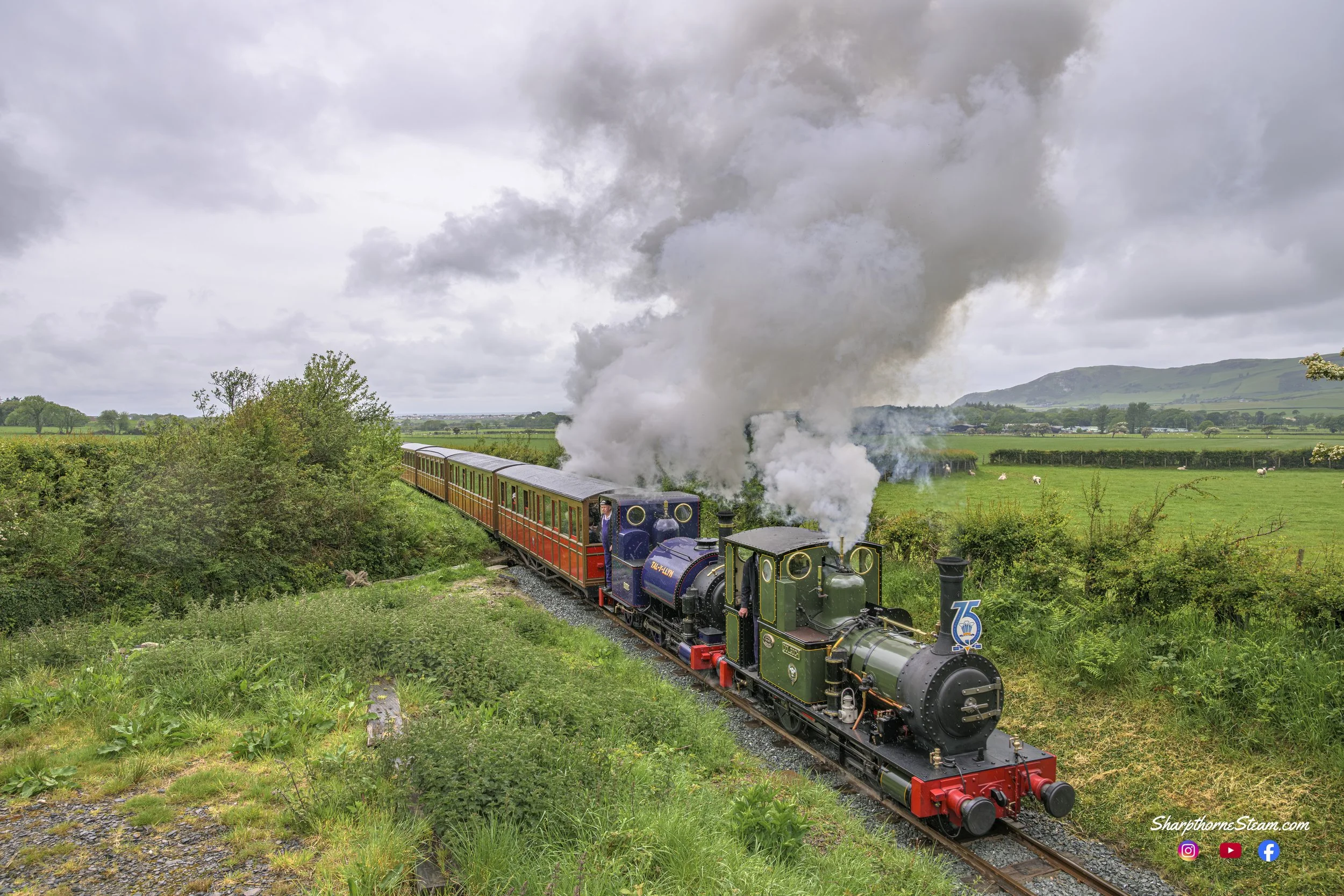
1 & 2 Double Heading - No1 and No2 are seen at Cynfal Bridge with the Saturday afternoon double-header, with No2 leading and using her whistle to great effect
Camera Settings: Body: Nikon Z8 Lens: Nikkor Z 24-70f4 Focal Length: 24mm Shutter Speed: 1/400 Aperture: f8.0 ISO:160
At Tywyn, we opted to eat at the station restaurant, knowing it would be a long evening. A steak and ale pie, accompanied by an impressively generous mug of tea, hit the spot perfectly. Shortly after finishing, I received a message from Luke asking if I’d like to visit the operational shed at Pendre Works for a guided tour of the 1860s-era facility.
Naturally, there was only one answer to that question.
We caught the next departure from Tywyn, taking the short trip to Pendre, far more appropriate than walking. Unfortunately, No.7 had suffered an injector issue, so No.1 took charge of the 19:40 service. On arrival, having already passed the down train, we were welcomed inside and introduced to the working heart of the railway.
Luke’s guided tour of the shed was one of the unexpected highlights of the entire weekend. Watching the team bring locomotives in after a full day’s work, and hearing the stories behind them, was a privilege. Night photography in an engine shed is something I absolutely love, especially when it’s unplanned, and I’d already earmarked several compositions when we had been walking through the shed. Dolgoch, fast becoming my favourite engine of the weekend, was perfectly positioned on shed and proved irresistible.
One standout moment was watching No.3 move onto shed and stop in exactly the right place for a photograph, complete with face, adding an extra layer of character. I became so absorbed in photographing No.3 and No.2 that, despite Luke mentioning our return train was in Pendre, I completely lost track of time.
Technical callout – Pendre night photography
Lens: Standard zoom
Focal length: ~16-50mm
Support: Tripod, I would recommend for sharp photos
Takeaway: Spontaneous night shots often produce the most atmospheric results
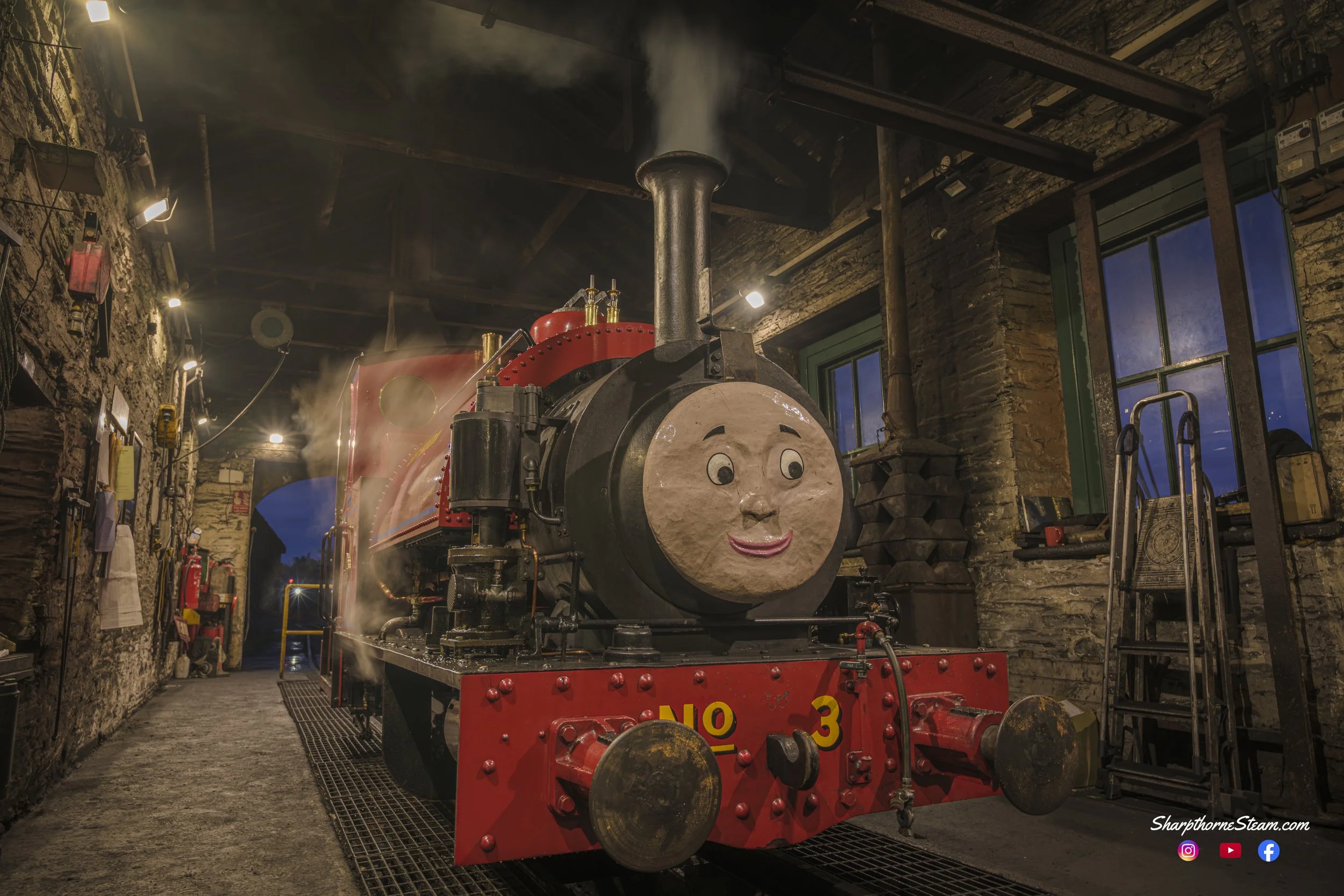
A Big Smile After a Hard Day - No3 on shed at Pendre with her 1980s Thomas face after having worked the Awdry Specials over the course of the Saturday.
Camera Settings: Body: Nikon Z8 Lens: Nikkor Z 24-70f4 Focal Length: 24mm Shutter Speed: 1/4 Aperture: f4 ISO:64
Eventually, with loads of photos taken and smiles all round, we said our farewells, thanked the team for their hospitality, and left a £10 donation in appreciation of the time and knowledge shared. By now it was shortly after 22:00, and with a long wait until the next train, we decided to walk back from Pendre to Tywyn to pass the time.
A passionate and enthusiastic conversation with an American visitor made the time fly, and just after midnight we boarded the final train back to Abergynolwyn, where the car had been parked that morning. We arrived shortly after 01:00, exhausted, but having experienced another unforgettable moment: night travel on the Talyllyn, this time in complete darkness, with no lights in the coaches.
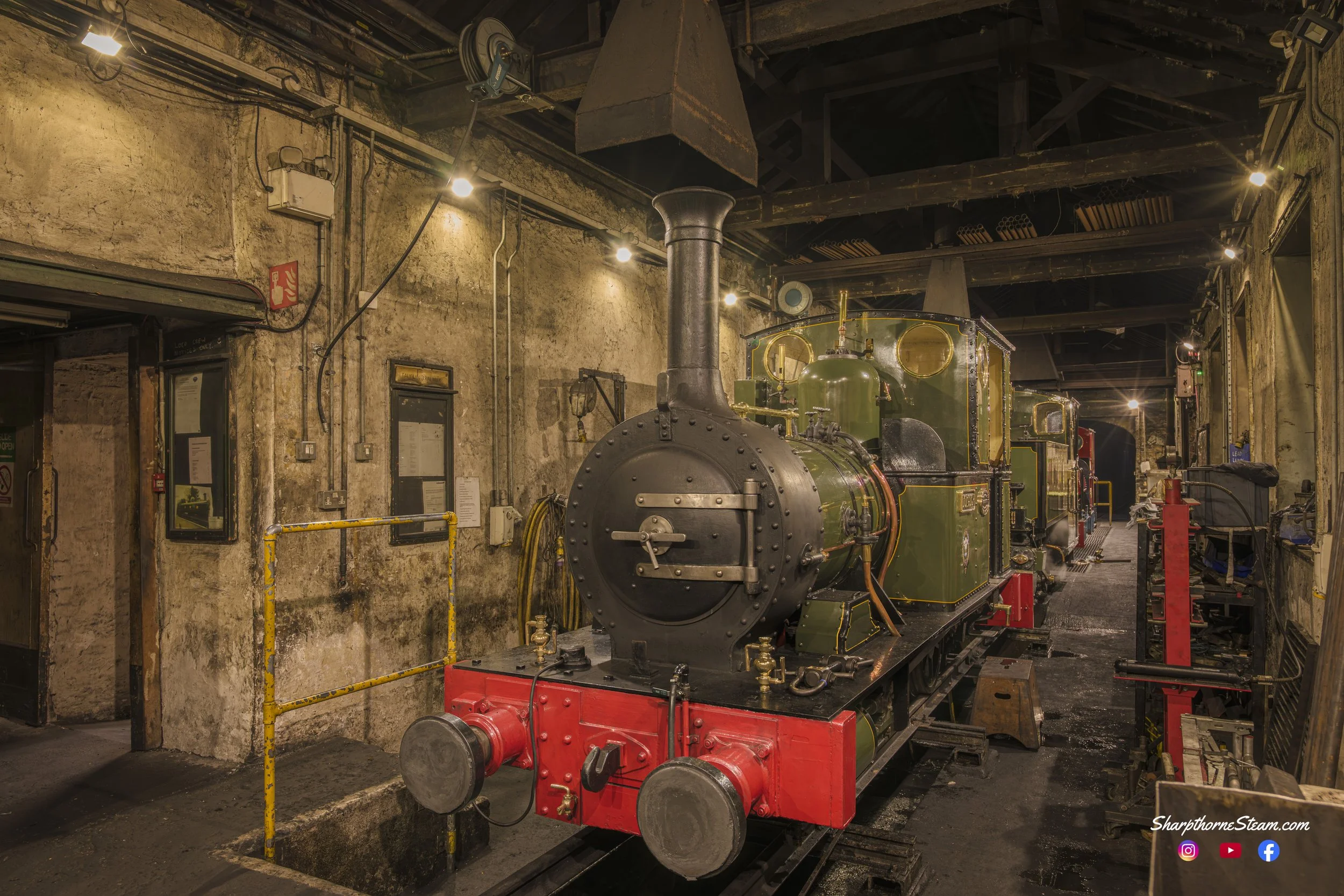
Engines on Shed - No2 “Dolgoch” is seen on shed with the failed No7 “Tom Rolt” and No3 “Sir Haydn”
Camera Settings: Body: Nikon Z8 Lens: Nikkor Z 24-70f4 Focal Length: 24mm Shutter Speed: 3/5sec Aperture: f6.3 ISO:160
Sunday
Sunday became the day where my planned departure time slowly, but consistently, slipped further and further into the afternoon. As the day wore on, I found more reasons to stay, more trains I wanted to see, and more photographs I felt compelled to take.
A set of roadworks meant the section just before Dolgoch Falls was closed, resulting in a rather scenic diversion. Mike and I found ourselves threading through narrow lanes and enjoying views of Craig yr Aderyn before eventually reaching Dolgoch Falls. Originally, my plan had been to leave after the Slate Special, hauled by Dolgoch, passed Quarry Sidings at 11:20. By this point, however, I was fully in the swing of the railway, and keen for my first proper narrow-gauge experience to continue for just a little longer.
The railway was running a double-header diesels featuring No.11 Trecwn and No.12 St. Cadfan, and along with No.1 Tal-y-llyn, these would form my opening shots of the day. For No.1, I tried a new spot just beyond Dolgoch station at the viewing platform. The weather was decidedly mixed, with bursts of sunshine interrupted by fast-moving cloud. Tal-y-llyn was hauling the first Cadi’s Train of the day, part of Sunday’s 1990s-to-present theme. This era also included the World Heritage Slate Train, which I’d already highlighted on the timetable as a must-see working.
I wanted that Slate Train on the sunny side of the line, so I made the decision to dash over to Quarry Sidings. Dash really is the correct word here, time was tight, and with five layers on to combat the lingering breeze, I ran across the hills with Dolgoch’s whistle echoing behind me. When I heard it, I was convinced I’d mistimed the move completely. My watch helpfully informed me my heart rate had hit 175 bpm, and I fully expected to crest the hill to find Dolgoch already sat in the loop.
Lady luck was firmly on my side. The train hadn’t yet arrived, and in hindsight I could have taken a much more leisurely stroll, but where’s the fun in that?!

World Famous Slate Train - No2 “Dolgoch” provides the honours as she pulls the slate train into Quarry Sidings
Camera Settings: Body: Nikon Z8 Lens: Nikkor Z 24-70f4 Focal Length: 24mm Shutter Speed: 1/400 Aperture: f6.3 ISO:64
I returned at a calmer pace to Dolgoch to capture what I thought would be my final shots of the weekend. First came a double-header with No.3 and No.4 on the Quarryman, followed by one of Sunday’s highlights: a mixed-traction double-header with No.7 Tom Rolt leading and No.11 Trecwn tucked inside.
Steam-and-diesel double-headers are a rare treat, and in truth, you’d barely know it was a double at all, Tom Rolt absolutely towered over Trecwn. Hopefully the footage conveys just how dramatic that contrast was.
At this point, I faced the inevitable dilemma: when to start the long journey back to Sussex? A drive of over six hours even with a break. My original plan had been to call it a day after No.7 and No.11. However, by now my growing fondness for No.2 Dolgoch got the better of me.
I decided on one final move: Abergynolwyn, specifically the radius curve on the exit towards Nant Gwernol.
Initially, I misread events. I assumed Tal-y-llyn would be significantly delayed due to an issue involving No.11 and Tom Rolt, and that the whistles I could hear were related to shunting movements. A quick glance at the Abergynolwyn railcam would have corrected that assumption—but by the time I realised, I’d missed the opportunity to film No.1 entirely. This sequence instead became a test run for what was now confirmed as my final shot of the weekend: Dolgoch.
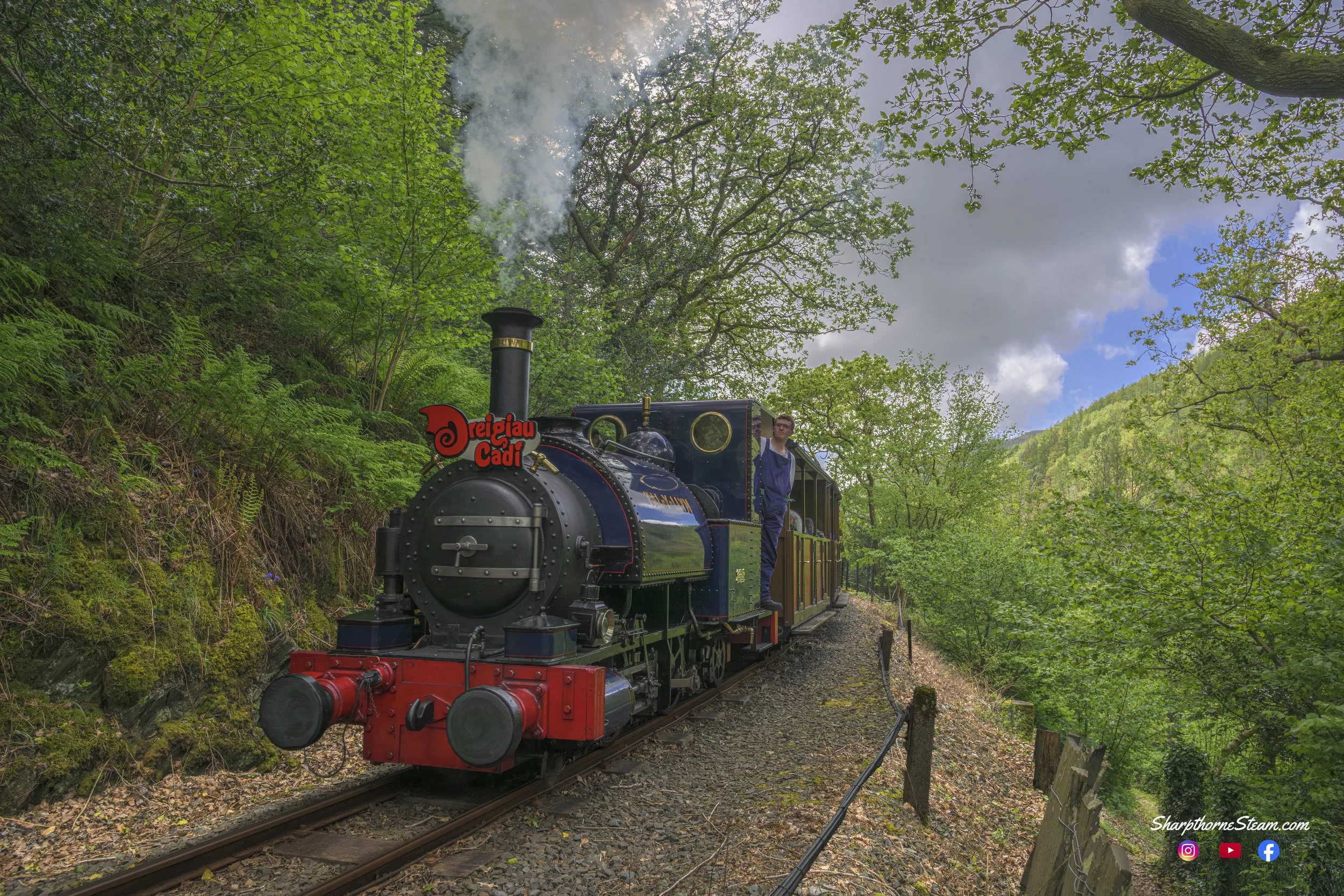
The Practice Shot - No1 departs Abergynolwyn on the Sunday afternoon
Camera Settings: Body: Nikon Z8 Lens: Nikkor Z 24-70f4 Focal Length: 24mm Shutter Speed: 1/400 Aperture: f6.3 ISO:125
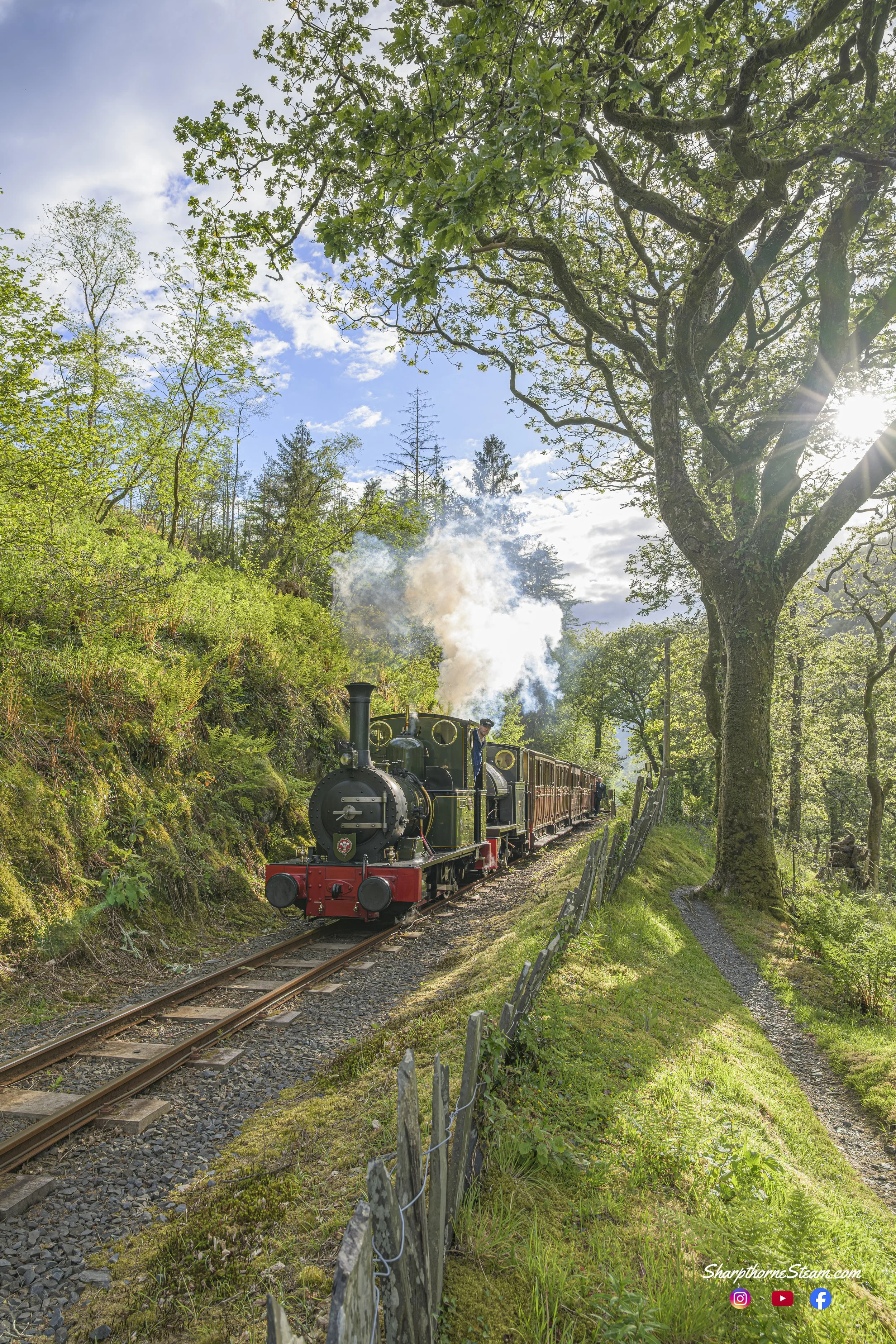
Landscape orientation simply didn’t work on the curve, cutting off the exhaust entirely, so I rotated the camera into portrait. That introduced another problem, the sun now sat right at the very top of the frame. By this stage, though, the weekend had already been about breaking rules: standing on the dark side, shooting directly into the sun, and generally doing what felt right rather than what convention suggested. So I leaned into it.
I waited patiently, watching the railcam and resisting the urge to overthink things. Dolgoch’s departure was suitably enthusiastic, perfectly setting the tone for the photograph. As the sound of her exhaust and the Forestry Crossing faded into the distance, it felt like the right moment to call time on the weekend.
I said my goodbyes, especially to Andrew, who had been instrumental in guiding Mike and me around the line, and braced myself for the long journey home.
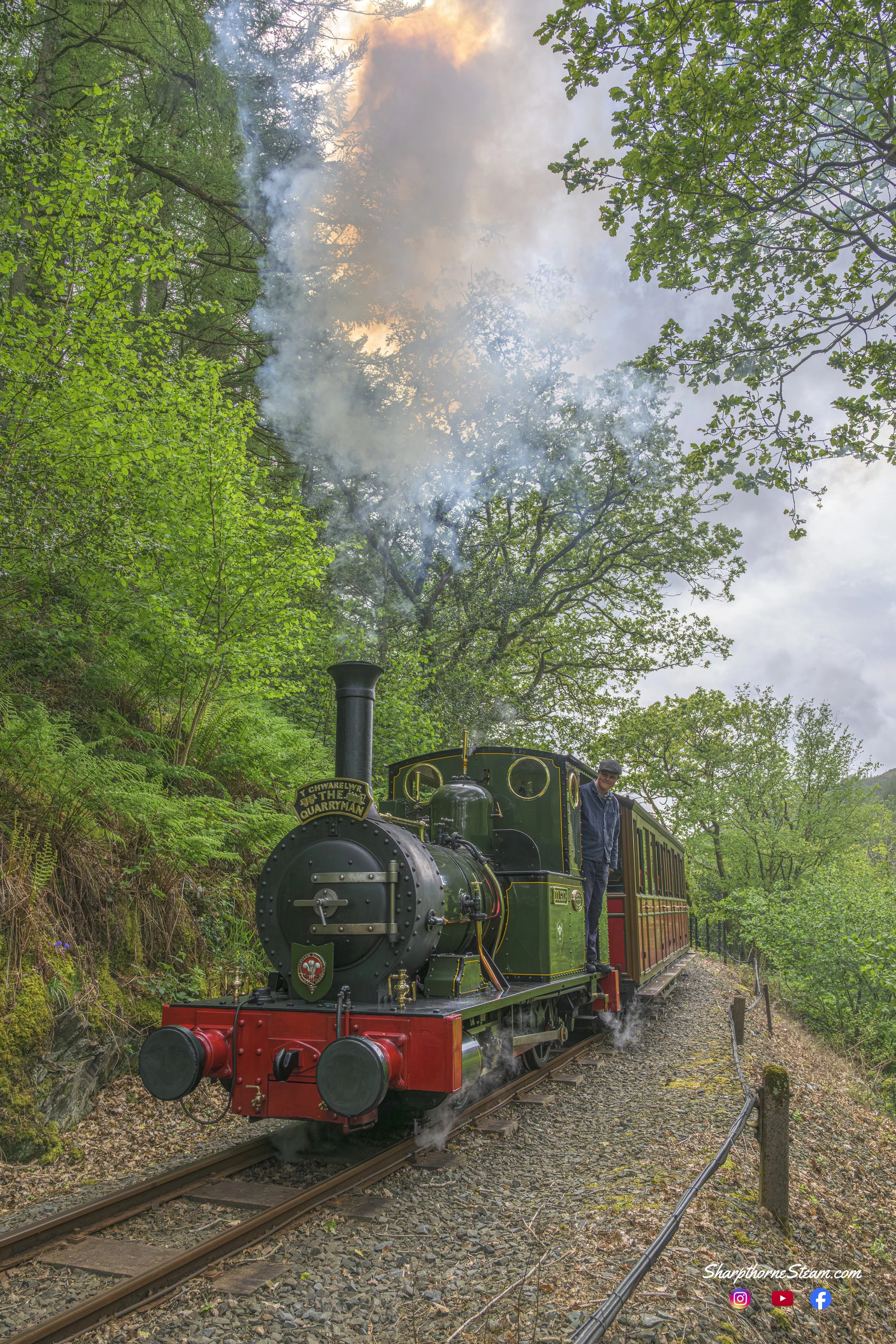
The Dolgoch Portrait - No2 “Dolgoch” powers out of Abergynolwyn with the second to last up service of the Sunday afternoon
Camera Settings: Body: Nikon Z8 Lens: Nikkor Z 24-70f4 Focal Length: 24mm Shutter Speed: 1/400 Aperture: f6.3 ISO:125
Final Thoughts
So, what were my thoughts on the Talyllyn Railway and narrow gauge as a whole?
Firstly, a huge thank you to Luke Ryan and the Talyllyn Railway Preservation Society for inviting me to attend the 75th Anniversary Gala. Reflecting on it now, a few days later as I write this on Thursday morning, I genuinely believe this was the standout gala of the first part of the season, closely followed by the West Somerset Spring Steam Spectacular.
What truly set the Talyllyn apart was the people. The volunteers were the stars of the show: welcoming, knowledgeable, and always willing to help. It was especially refreshing to see so many young volunteers involved, some travelling from as far afield as Essex to give their time. Standing in the idyllic and peaceful countryside of Mid Wales, it’s easy to understand exactly why they do.
Being invited along was a real honour, and as I left, I felt something I rarely do after a gala—sadness. Usually, I’m simply exhausted and ready for home. This time, I left reinvigorated. The weekend had reminded me why I fell in love with this hobby in the first place, and although this marked my last major fly-away gala for the first half of the year, it’s given me plenty of ideas for the future of Sharpthorne Steam.
If, like me, you live many hours away from the Talyllyn, I genuinely urge you to make the trip. Go and experience “The Railway with a Heart of Gold” for yourself—you never know, you might just catch the narrow-gauge bug too.
Thank you to once again to you all for reading through this amazing trip to the Talyllyn, there are a few more blogs coming out over the summer, the next one will be the trip with Saphos Trains with Sir Nigel Gresley. I wish you all a wonderfully warm Bank Holiday, in what is an action packed weekend with Clan Line’s trip on the Atlantic Coast Express, the Gloucestershire & Warwickshire’s Festival of Steam and many other events happening over the weekend. I myself, will be enjoying meeting up with one of favourite ladies, Beachy Head at Didcot, before returning home to Bluebell on Monday for more of a sun tanning session than a photography trip.
As always best wishes,
Ben